Many buyers think of an RFQ as a simple price request. It is not. A Request for Quotation is a package of documents that defines exactly what the buyer needs, and the way a supplier handles that package tells you a lot about how they will handle your project.
What is actually inside an RFQ
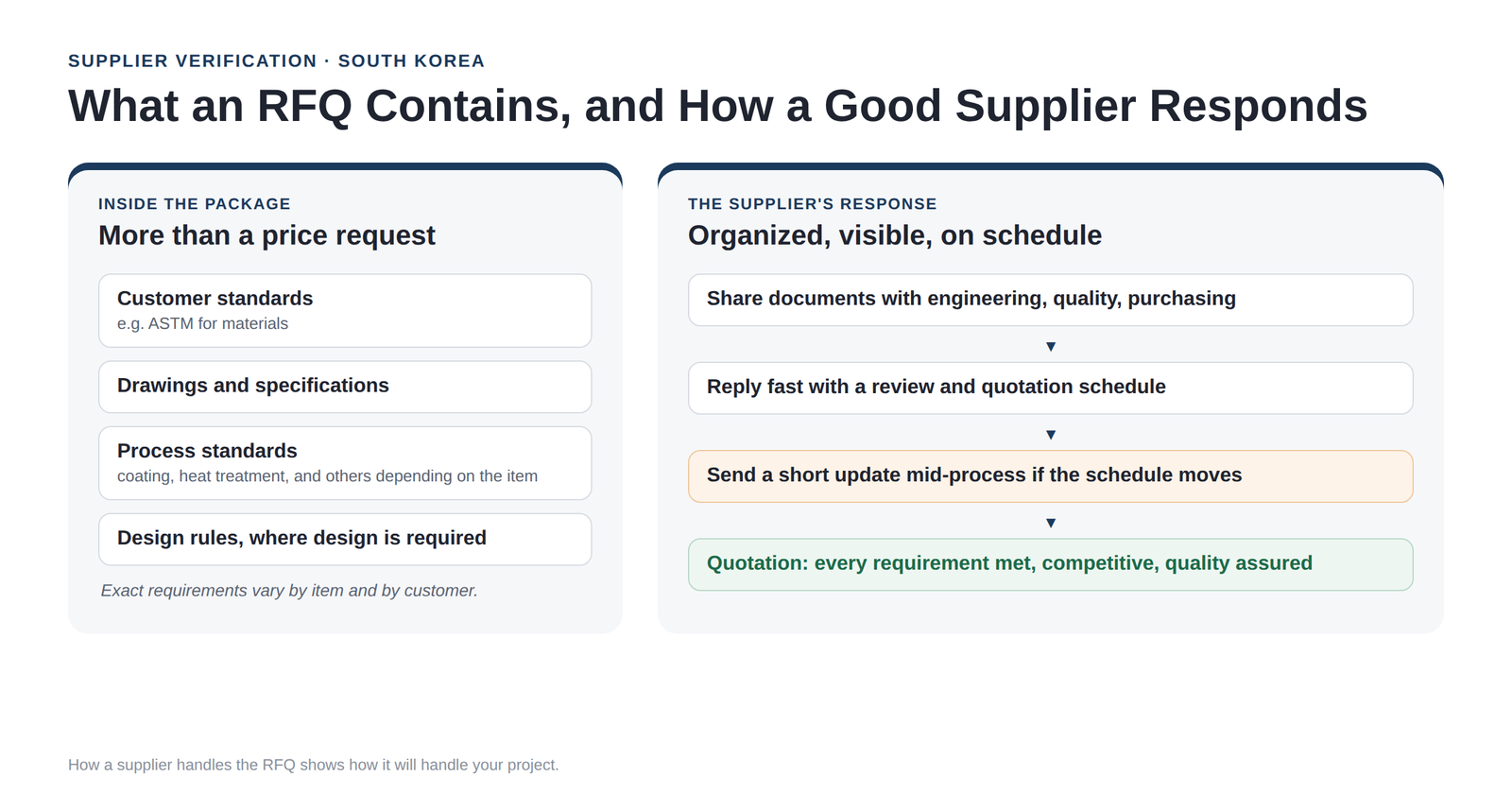
A real RFQ contains every standard and specification that applies to the item being quoted. If the item is a steel structure or a piece of machinery and the customer is in the United States, the package typically includes American standards, such as ASTM specifications for the steel. If the preliminary drawing calls for painting on some surfaces and heat treatment on others, the coating specification and the heat treatment standard are in the package too, along with any other standards that apply to the item. Where design work is required, the design rules must be followed as well. The same applies whether the product is an automotive part or industrial equipment.
So the supplier is not just pricing a product. They are being asked to confirm that every customer requirement can be met, and to reflect all of it in the price.
Receiving an RFQ already says something
A buyer who sends an RFQ generally already has real information about the company. Often that comes from a process audit or a factory visit that qualified the supplier to bid. Being invited to quote means the supplier has passed a first level of checking. As a supplier, it means the buyer is serious. As a buyer, it means your own screening comes first, and the RFQ is the next step in the evaluation.
Why quoting is harder than it looks
A good quotation has to do three things at the same time. It must reflect every requirement in the documents. It must be competitive against other suppliers. And it must come with a quality commitment the supplier can actually keep. That is a lot to review, and a supplier that does it carefully will often look slower than one that simply sends a number.
How a well-organized supplier handles an RFQ
Companies with a proper team do not leave the RFQ on one person’s desk. They distribute the documents to the relevant people, such as engineering, quality, and purchasing, so each part is reviewed by someone who understands it.
They also do not make the buyer wait in silence. They reply quickly with a schedule: when the review will be finished and when the quotation will be submitted. Only then do they begin the internal review.
If the review takes longer than planned, they say so before the deadline. A short update by email in the middle of the process is one of the simplest and most effective habits. When a buyer knows the schedule may move and why, they usually understand. When a buyer hears nothing, they assume the worst.
If the buyer has a required date, the two sides agree on a schedule together. A supplier that negotiates a realistic date is usually more reliable than one that agrees to anything.
What a Korean supplier’s RFQ response tells you
Before you visit any factory, the way a supplier responds to your RFQ can show you:
- Whether they acknowledge the request quickly and give you a clear schedule
- Whether they read the whole document package, including the specifications, not only the drawing
- Whether they ask clarifying questions instead of guessing
- Whether they keep you informed during the review
- Whether the quotation reflects your standards or only gives a price
A supplier that does these things is organized, understands international requirements, and treats communication as part of the work. A supplier that sends only a low price with no questions may not have read the specifications, and that is a risk you want to see before an order, not after.
Where this fits in supplier verification
The RFQ response is one piece of a larger picture. It works best alongside the checks described in How We Select a Korean Manufacturer and Two Red Flags Most Buyers Miss, and you can score what you see with the free Supplier Verification Checklist.
If you are preparing an RFQ for Korean suppliers and want help reviewing the responses, get in touch.
Next in this series: After You Submit the Quotation: The Documents Buyers Expect from a Korean Supplier
Written by Cheolho Shim, founder of KoreaLiaisonPM in Busan. Twenty years in automotive OEM supply chains and mining infrastructure projects. About me →
Leave a Reply