Category: Sourcing Verification

  • Supplier Verification Checklist: Two Red Flags Most Buyers Miss

    Supplier Verification Checklist: Two Red Flags Most Buyers Miss

    A supplier checklist is a good place to start. It tells you what to look at. But a supplier can pass a checklist and still cause trouble once the project begins. In my experience, the risk tends to hide in two places that a checklist rarely captures: what happens after an audit finds a problem, and how the supplier communicates with you.

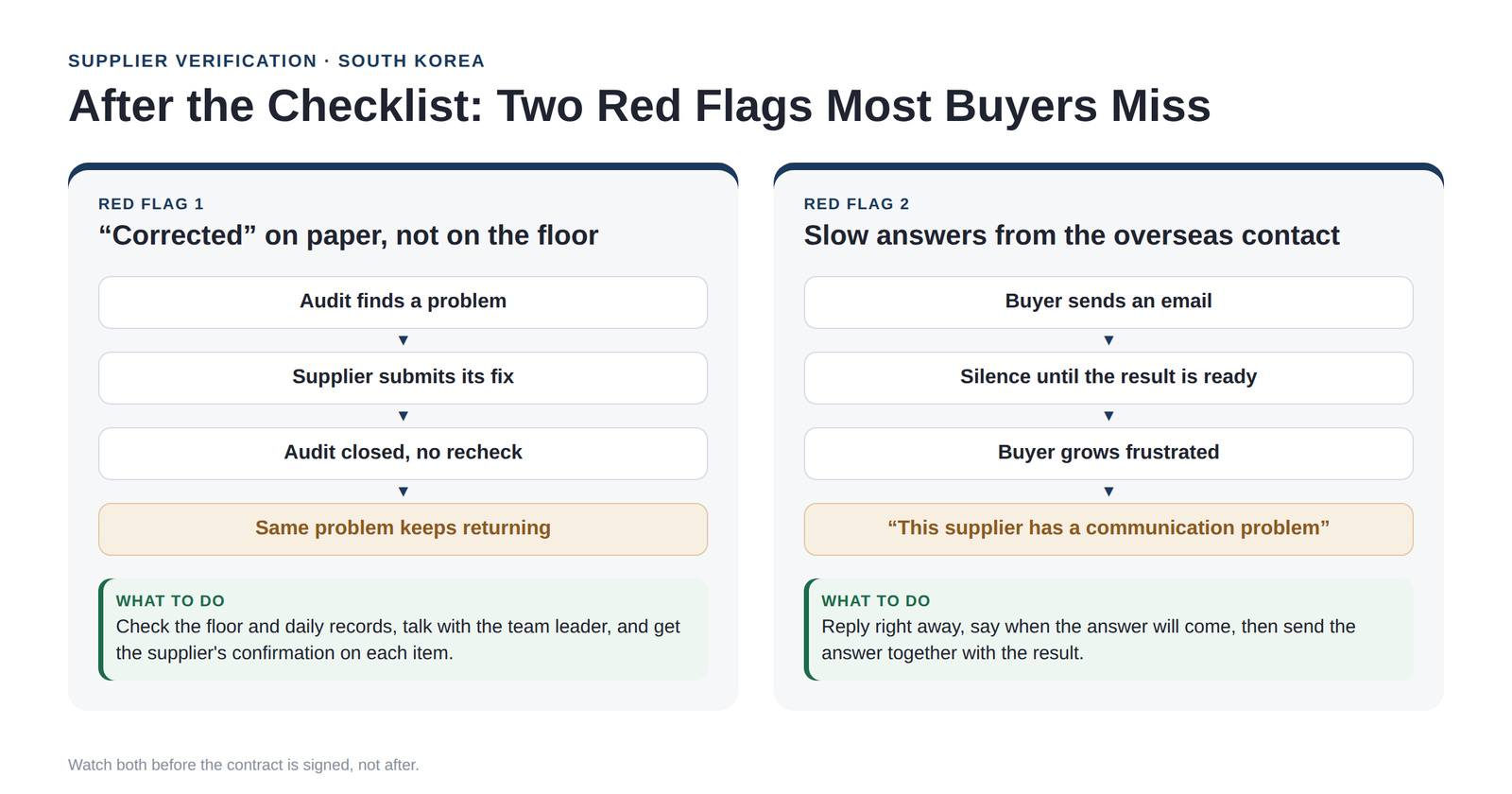
    Red flag 1: “Corrected” on paper, but the problems keep coming back

    Here is how many audits end. The auditor goes through the supplier with a checklist, records the problem areas, and reports them to the company. The company fixes or improves those items and submits its response to the auditor. In many cases, that is where it stops.

    Ideally, the auditor would visit once more to confirm that the improvements actually reached the shop floor. Some do. But often the auditor takes the company at its word, decides the problem has been resolved, and closes the audit.

    The difficulty is that even a real improvement is hard to judge from a document. The auditor may not know the process well enough technically to tell whether the fix addresses the true cause. And no one outside the company can be sure whether the change was made from the right point of view: one that solves the problem for the buyer, or one that merely closes the finding. Buyers then end up asking the same question: we were told this was improved, so why does the same problem keep happening?

    This is where problems most often arise, so it deserves close attention:

    • Do not treat a submitted corrective response as proof. Read what exactly was changed and why.
    • Check whether the change shows up on the floor and in the daily records, not only in a revised document.
    • Spend real time talking with the supplier’s responsible team leader. Those conversations often reveal whether the team understands the cause of the problem.
    • Get the supplier’s confirmation on each corrected item before you rely on it.

    Realistically, an audit cannot run for days on end. That is exactly why the time you do have should go to the items that failed, and to confirming that the fix is real.

    Red flag 2: Slow answers from the overseas contact

    These days, even small and mid-sized Korean manufacturers rarely have a serious English problem. The more common risk is a person in the overseas contact role who has little experience with overseas buyers. If they do not understand how overseas buyers think and work, the project can become difficult in unexpected ways.

    The best remedy is fast feedback. When I handled overseas sales, I would read a buyer’s email in the morning and reply right away: we have received it, and after meeting with the team we will get back to you by a specific date. Then I held the meeting and sent the answer together with the result. The buyer sees that someone is paying attention to their email, and when the result arrives, concludes that this contact can be trusted.

    The common pattern is the opposite. The contact waits until the result is ready and only then replies. In the meantime, the buyer hears nothing and grows frustrated. After a few rounds of this, the buyer decides that the supplier has a communication problem.

    Real communication is simple: read the email, make a judgment, reply quickly, then gather the answer with the relevant team and send it. When you evaluate a supplier, watch how fast and how clearly the overseas contact responds before the contract is signed, not after.

    Where the checklist fits

    A checklist is still worth using. It organizes what to look at across documents, on-site checks, finances, and communication. My free Supplier Verification Checklist covers twelve items across those areas and gives you a quick read on how well screened a supplier is.

    The two red flags above are what I look for beyond the checklist when I audit and manage suppliers. To see how an on-site audit works, read What a Manufacturing Process Audit in South Korea Actually Looks Like. To see how I combine sourcing, audit, and project management, visit the Services page.

  • What a Manufacturing Process Audit in South Korea Actually Looks Like

    What a Manufacturing Process Audit in South Korea Actually Looks Like

    Many overseas buyers hear “we’ll audit the factory” and picture a clipboard and a quick tour. In practice, a proper process audit in Korea is a structured comparison between what the factory says it does and what actually happens on the shop floor. Here is how it works, based on the audits I have run on Korean suppliers.

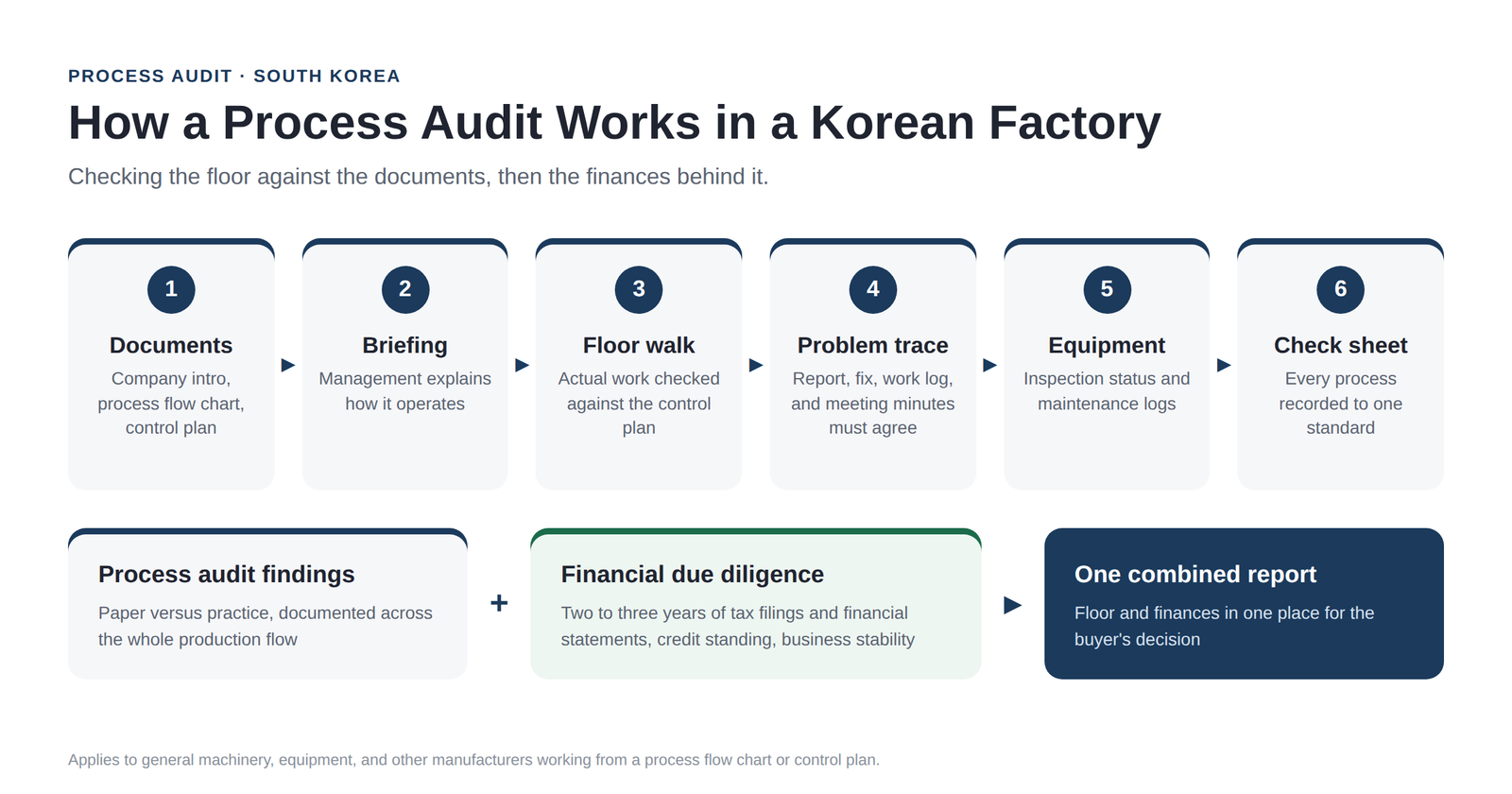
    Step 1: Documents come first

    Before anyone visits the site, I request the supplier’s core documents: the company introduction, the manufacturing process flow chart, and the control plan. The control plan is the key one. It defines, process by process, what is checked, how often, and what happens when something goes wrong. Everything on the floor is measured against it.

    Step 2: The visit begins with the company, not the factory

    On audit day, the supplier first presents the company: what they make, who they supply, and how they are organized. This is not small talk. It tells me how the management understands its own operation, and it sets up the questions I will ask during the walk-through.

    Step 3: Walking the floor with the control plan in hand

    Then we walk the actual production line, with the process flow chart and the control plan in hand. I carry my own check sheet too, but in practice the two are very similar, because the check sheet is built on the control plan’s standards. The core question at every station is simple: is the work being done the way the documents say it is?

    Step 4: Following a problem all the way through

    This is where an audit gets real. I do not stop at “is there a procedure.” I follow what happens when something goes wrong:

    • Was the problem reported to the people above the operator?
    • After the report, was the process actually corrected?
    • Does the correction show up in the daily work log?
    • Do the work log and the meeting minutes from the problem meeting tell the same story?
    • On the floor today, has the problem really been fixed?

    A supplier can have a perfect procedure on paper. If the work log says one thing and the meeting minutes say another, or if the fix never reached the line, that gap is exactly what the audit exists to find.

    Step 5: Equipment and maintenance records

    At each process I also check the machine in use: has it been inspected, and is there a maintenance log to prove it? Each item goes on the check sheet, one by one. A machine that runs well today but has no inspection record is a risk, because the next breakdown will have no history to learn from.

    Step 6: Recording everything on the check sheet

    By the end of the walk, every process has been checked against the same standard and recorded. The result is not an impression, it is a documented comparison of paper versus practice for the whole production flow.

    A process audit alone is not enough: financial due diligence and the report

    Even a well-run floor can sit inside a financially fragile company, and that risk can surface in the middle of your project. So I pair the process audit with financial due diligence. I analyze the supplier’s tax filings and financial statements for the last two to three years, along with credit standing and business stability, to confirm you are getting not just a capable factory but a stable one.

    The on-site audit findings and the financial due diligence results are combined into a single report for the buyer. You see the paper-versus-practice comparison, what was observed on the floor, and the supplier’s financial position in one place, and can make your decision from there.

    Which suppliers does this apply to?

    This approach applies to general machinery and equipment manufacturers, and to any manufacturer that works from a process flow chart or control plan. The industry changes, but the logic of the audit does not: check the floor against the documents.

    What this means for buyers

    If a supplier can show you consistent documents, a floor that matches them, a clear trail from problem to correction, and a stable financial position, you are looking at a supplier that manages itself. If not, you want to know before the purchase order, not after.

    For how this fits into a full supplier evaluation, read Sourcing Korean Suppliers: Two Paths for Overseas Buyers. To see how I combine sourcing, audit, and project management, visit the Services page.

  • How KoreaLiaisonPM Actually Selects a Korean Manufacturer

    How KoreaLiaisonPM Actually Selects a Korean Manufacturer

    A few years ago, a buyer had already signed with a Korean supplier through a different sourcing agency. The certifications were there. The quote was reasonable. On paper, everything checked out. But a few months into production, problems from aging equipment started showing up again and again. Nothing in the paperwork had flagged it. A certificate tells you what a piece of equipment is capable of — not what it’s actually doing right now.

    “How do you choose the right factory?” It’s the question I get more than any other from overseas buyers. Most people underestimate how hard this question really is. Finding a list of Korean manufacturers takes a few searches. The hard part is knowing which one is worth staking your project, your budget, your timeline — and ultimately your reputation — on.

    Over the past year, I’ve written about different pieces of this process separately — the red flags I watch for, why financial due diligence matters as much as a factory audit, what actually happens once production starts. This post pulls those pieces together into the sequence I actually follow, start to finish.

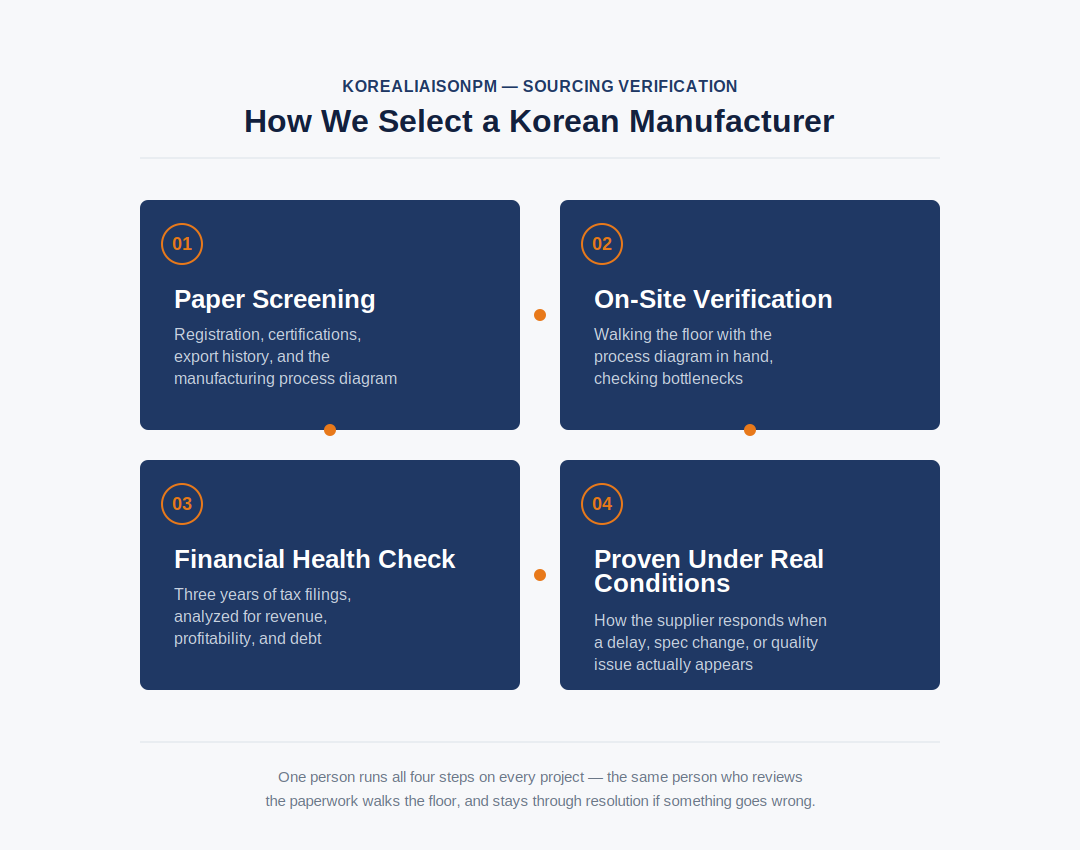
    Step 1: Paper Screening

    Before I visit anywhere, I start with documentation — business registration, relevant certifications (ISO and industry-specific standards), export history, and equipment lists. Beyond that, there are two things I always request: a company profile and a manufacturing process diagram.

    A company profile tells you how a company describes itself. A process diagram tells you something far more useful — the actual sequence of raw material intake, processing, inspection, packaging, and shipment, along with exactly where quality checkpoints sit within that sequence. A company with no process diagram, or one that’s suspiciously oversimplified, is itself a signal — it may mean the process was never standardized, or that things get handled ad hoc, project by project.

    This step looks simple, but it’s where most candidates actually get filtered out. A certification issued years before the equipment it supposedly covers was installed isn’t necessarily disqualifying on its own — but it raises a question: is this equipment still meeting that certification standard today? Any candidate that leaves that kind of question unanswered doesn’t move to the next step.

    Step 2: On-Site Verification

    This is where paper stops being enough. [Link: 10 Red Flags I Look For] The first thing I do on-site is walk the floor with the process diagram from Step 1 in hand, following it exactly. Does the actual line layout match the documented sequence? Are inspections actually happening at the checkpoints shown on the diagram? Are there any workaround steps in practice that don’t appear on paper at all?

    This is almost always where bottlenecks surface — work-in-progress piling up at a particular station, long wait times in front of certain equipment. What matters isn’t that a bottleneck exists; every factory has one somewhere. What matters is how the company handles it. Did they add capacity? Adjust shift scheduling? Or just let deadlines slip and hope no one notices? I ask directly, and I pay attention to whether the answer is specific or vague. A company that gives concrete numbers and concrete actions has clearly dealt with this problem before. A vague “we adjust as needed” is itself a warning sign.

    I also check whether equipment age matches what’s on paper, and look for small inconsistencies a certificate would never reveal — a tolerance range that doesn’t match what the machine is actually producing, a maintenance log that was clearly filled in all at once, a worker on the floor who isn’t the person listed as responsible on paper. None of this shows up as a yes/no on a checklist. It only shows up when you walk the floor yourself, diagram in hand, and ask.

    Step 3: Financial Health Check

    A factory can look solid on the floor and still be financially unstable — and that risk never shows up in a walkthrough. [Link: Financial Due Diligence vs. Factory Audit] For this, I request the company’s tax reconciliation statements, typically covering the past three fiscal years, and analyze revenue trends, profitability, and debt structure. From that, I put together a short internal assessment of whether this is a company likely to remain stable — and reliable — two or three years into a partnership. This matters because when a supplier runs into financial trouble, quality control and delivery reliability are usually the first things to break down. Less money means fewer people, and fewer people means quality suffers next. That sequence rarely changes. Most buyers never think to ask for this — but it’s often the difference between a supplier who delivers once and one who delivers for years.

    Step 4: Proving It Under Real Conditions

    Verification doesn’t stop once a supplier is selected. [Link: Case Study: Kazakhstan Copper Mine] [Link: Case Study: Aktogay] The real test comes when something goes wrong — a delayed shipment, a quality issue, a spec change mid-production. [Link: What Happens After Equipment Is Finished] That’s when a supplier’s real character shows, in ways no document or site visit ever could. Do they flag the problem early, or does it surface only after you catch it? Do they show up with a solution, or with an excuse?

    Comparing Candidates Side by Side — and the Problem with Scores

    Most buyers don’t decide based on a single candidate. They evaluate two, three, sometimes more, and choose one. A common approach here is checklist-based scoring — assigning points across categories and picking whoever adds up highest. Many audit firms use this method for good reason: when multiple auditors are evaluating multiple companies, standardized scoring keeps judgment from varying wildly from person to person.

    The problem is that a score measures whether something was checked, not whether it’s still true. A point awarded for holding an ISO certification counts the same whether that certification is five years old or was issued yesterday — even if the equipment behind it has completely changed since. A company without the certification, but with genuinely tighter process control, can end up scoring lower. Checklists guarantee consistency. They don’t guarantee that the consistent score reflects the actual risk.

    So when there are multiple candidates, instead of assigning scores, I lay out the actual findings from the steps above — especially on-site verification and financial health — side by side. Not “Company A: 92, Company B: 87,” but specific, concrete statements: this company’s floor matches its process diagram but handles bottlenecks poorly; that company has strong equipment but a debt ratio that’s been climbing for two years. What matters isn’t which number is higher — it’s which company is strong or weak, and exactly why.

    Why the Big Names Get Noticed First

    There’s another problem worth naming directly. Whether a company can communicate in English, holds international certifications, or has a dedicated export sales team — these are heavily weighted in most evaluation frameworks. None of them have anything to do with technical capability or financial health. And nearly all of them favor larger companies by default.

    The result is that genuinely strong small and mid-sized manufacturers — companies with excellent technical capability and solid financials — often never make it onto a shortlist at all, simply because they lack English-speaking staff or experience dealing directly with overseas buyers. Buyers never even learn these companies exist. Overseas buyers end up returning to the same well-known larger companies again and again, regardless of actual merit, while capable smaller manufacturers never get a fair shot.

    This is part of what I do on the ground. I speak the language, understand international business practices, and can package information the way buyers expect — which means I can close that gap on a company’s behalf. A strong manufacturer that had no way of reaching overseas buyers on its own gets evaluated on merit. And buyers, in turn, aren’t limited to the handful of names everyone already knows — they get access to real capability across a wider field.

    Why This Matters

    None of these steps are complicated on their own. What’s hard is doing them for every project, without exception, to the same standard. There’s always a temptation to skip the site visit when the schedule is tight, or skip the financial check when the paperwork looks clean.

    At larger sourcing firms, these steps are usually split across departments — sales handles documentation, quality handles the site visit, a separate due diligence team handles finances, and a PM handles it if something goes wrong. There’s a real advantage to this structure: expertise builds up at each stage, and it scales well for large projects. But when responsibility passes through that many hands, there’s always a moment where something can fall through the cracks of “whose job was that.”

    I run all of these steps myself, on every project. The person who reviewed the documentation and process diagram is the same person who walks the floor. The person who looked at the financials is still there if something goes wrong later. It’s not a structure built for running many large projects at once — but it’s built to make sure nothing on a single project gets missed.

    If you’re evaluating a Korean supplier and could use a second set of eyes on any part of this process, feel free to reach out.

    Want to check a candidate yourself first? Try our free Supplier Verification Checklist — it walks through the same four steps above and takes about two minutes.

  • After the Shipment Arrives — Technical Documentation and On-Site Engineer Support

    After the Shipment Arrives — Technical Documentation and On-Site Engineer Support

    In the last post, I covered the moment finished equipment gets loaded into a container and leaves port. Plenty of buyers assume the project is essentially done at that point — the container arrives, the equipment is intact, so what’s left?

    In reality, once equipment reaches its destination, another important stage begins. This post covers that closing stretch: the technical documentation package, and — when requested — the on-site engineer dispatch that sometimes follows it.

    The technical documentation package — why it matters

    Even perfectly built equipment is only as useful as the local engineers’ ability to assemble it, operate it, and know what to do if something goes wrong. That’s why, after shipment, we put together a full technical documentation package — bound as an actual book, not just a PDF.

    This package typically includes:

    • Final approved drawings — the confirmed version actually used in production
    • Assembly instructions per unit — step-by-step guidance for reassembling components on-site
    • Operating manual — how to actually run the equipment
    • Troubleshooting guide — common issues and how to respond to them

    Why it’s built in the customer’s language

    There’s one principle that matters here: the documentation gets built in the customer’s actual language. For an English-speaking client, one English edition covers it. For a project in Kazakhstan, where Russian is widely used alongside English, we produce two separate editions — one in English, one in Russian.

    The reason is simple. Even the most carefully written documentation is useless if the local engineers can’t fully understand it. Operating manuals and troubleshooting guides in particular need to be something engineers can reach for in the moment, on the floor — and that only works in a language they actually think in. Handing over an English-only document and expecting people to “figure it out” treats documentation as a box to check, not something meant to actually help.

    Once each language version is finalized, we produce it as a physical bound book and mail it out. Sending a PDF and sending an actual book someone can hold carry a genuinely different weight with a customer.

    On-site engineer dispatch — what documentation can’t cover

    Documentation handles most situations. But when a customer requests it, we also arrange for a Korean engineer to travel on-site and support the actual installation directly.

    The cost structure is straightforward: airfare, accommodation, and hourly compensation are covered by the buyer. The engineer travels with the same technical documentation package already described, working alongside the local engineering team to get the equipment installed.

    Here’s something not often talked about: many engineers genuinely dread these trips, even though it’s an opportunity to earn more. Two reasons come up consistently.

    First, most engineers aren’t especially comfortable in English, so either an interpreter travels with them or a PM goes along to handle communication directly. Second, installation sites are rarely in or near a city — they’re usually well outside it. The Kazakhstan project I’ve mentioned in earlier posts was at a mining site, and getting there in person meant genuinely difficult conditions. That’s not just true for the engineer — the PM traveling alongside experiences the exact same thing.

    Even so, there’s a real reason this trip has to happen. Documentation, however thorough, can’t cover everything. No assembly manual anticipates every variable that shows up on-site — local power conditions, small mismatches in installation space, things that simply weren’t visible on paper. Having someone from the team that actually built the equipment physically present cuts that installation risk down significantly.

    And there’s real satisfaction on the other side of the difficulty. Working through problems alongside local engineers in an unfamiliar setting, and then watching the equipment run without issue once it’s finally powered up — that moment is what makes the trip worth it. The harder the conditions, the more that final moment tends to mean.

    What this service represents

    I consider engineer dispatch one of the most valuable things I’ve built over twenty years in this field. It’s not just “we build it and ship it” — it’s staying responsible for the equipment until it’s actually running correctly on-site. Being able to offer that level of support comes from having personally been through the entire cycle — design, manufacturing, packaging, shipment, and installation — not just one piece of it.

    Why this matters

    Everything in this series — timing schedule management, handling production problems, packaging through shipment, and now documentation and engineer dispatch — is really one continuous story. Staying responsible for a project from the moment it starts to the moment the equipment is actually running on-site, wherever that site happens to be. That’s what project management actually means, in my view.


    This is part of a series on sourcing and project management in Korea, based on direct experience managing manufacturing and industrial projects across automotive and heavy industry supply chains.

  • What Happens After Equipment Is Finished — Packaging Through Shipment

    What Happens After Equipment Is Finished — Packaging Through Shipment

    In the last post, I talked about what actually happens when a serious problem shows up mid-production. This post picks up after all of that is behind you — after the equipment is finally, actually finished.

    For a buyer, hearing “it’s finished” can feel like the finish line. After months of watching a project move forward, that news naturally feels like the end. But in practice, this is where another precise stage begins. Even perfectly built equipment can arrive damaged, or get held up in customs, if packaging and shipping aren’t handled carefully. I’ve seen months of careful work come under real strain in the final few weeks more than once.

    Packaging — it’s not just putting things in a box

    Getting finished equipment ready to load into a container is its own discipline. Every piece of equipment has a different center of gravity, different protruding parts, different components sensitive to shock. That means packaging can’t just be “make it fit the container” — it has to be worked out component by component.

    Piping, for example, gets fabricated in a modular, assemble-on-site format specifically to optimize packing space. Rather than packaging it as one finished, fully-assembled unit, breaking it down into components that can be reassembled on-site cuts the packed volume significantly — and it actually makes the on-site reassembly process more structured, not less. This only works if it’s planned from the design stage onward, with an eye toward how the piece will eventually be packed and shipped. Trying to figure this out after assembly is already complete usually means dismantling something that was never designed to come apart.

    Electrical panels need a different approach entirely. The main panel and every auxiliary control panel are engineered and arranged to fit inside the 20-foot container itself. Panels run the entire system once it’s installed, which makes them especially sensitive to shock — but by planning out the container’s internal space in advance and securing everything properly, they can be transported safely without needing large custom wooden crates. If a panel gets damaged in transit, it can mean remanufacturing or reshipping it from scratch, which is exactly why the securing work at this stage gets as much attention as anything earlier in the project.

    The logic behind handling each component differently is simple: less volume means lower shipping costs, and solid securing means lower risk of damage. Optimizing both, component by component, is what packaging actually looks like from a PM’s side.

    Why I document loading in stages

    While packing and loading are underway, I photograph the process in stages and send it to the buyer. Pre-loading condition, secured-in-place condition, and the final loaded state right before the container doors close — the buyer sees that whole sequence.

    The reason is simple. A buyer who can’t be there in person has no other way to confirm that their equipment is actually being packed and loaded safely — these photos are the only window they have. This matters even more on projects where something went wrong earlier; being fully transparent at this final stage does a lot to settle any lingering unease from earlier in the process.

    There’s a practical side too. If there’s ever damage during transit, these photos become clear evidence of the condition at departure. If an insurance claim or a liability question with the shipping carrier comes up later, having a timestamped photo record is a completely different situation than trying to explain it after the fact.

    Shipping documents and final payment

    Once packing and loading are complete, shipping documents get prepared and sent to the buyer — the commercial invoice, packing list, bill of lading, and whatever else customs and transport require. These documents are what customs clearance and shipping run on, and final payment is typically collected once they’re delivered.

    This stage needs to be checked carefully, because even one missing or incorrect document can hold everything up in customs. A single wrong number or mislabeled item on paperwork can flag the shipment at the destination port — and then a container that arrived physically intact ends up stuck at the port anyway. That’s exactly why this step still needs a PM’s attention, even after the factory floor’s part of the job is done.

    Shipment

    Once documentation and final payment are settled, the actual shipment goes out. This is where the manufacturing side of the project effectively ends and the logistics side takes over. Even after the container leaves port, I think it’s worth staying with the project — sharing the expected arrival date and continuing updates until it actually gets there.

    Why this matters

    None of this stage is dramatic. There’s no technical crisis to solve, no tense moment to describe. But cutting corners here can undo the equipment that took months to build correctly — through transit damage or a customs hold that never should have happened. It’s a genuine shame to see trust built carefully over an entire project get shaken by carelessness in the last few weeks.

    From the start of a project through this point — timing schedule management, handling problems mid-production, and now packaging through shipment — it’s really one continuous thread. Any single stage handled carelessly can undermine everything that came before it. That’s something twenty years of running these projects has made clear.

    Next in this series: what happens after shipment, once the equipment arrives on-site — the technical documentation package that gets prepared and handed over.


    This is part of a series on sourcing and project management in Korea, based on direct experience managing manufacturing and industrial projects across automotive and heavy industry supply chains.

  • What Actually Happens When a Serious Problem Shows Up Mid-Production

    What Actually Happens When a Serious Problem Shows Up Mid-Production

    In the last post, I talked about the weekly routine of visiting the site, documenting progress with photos, and logging everything in the remarks column. That routine isn’t really about preventing problems — it’s about making sure that when something does go wrong, it gets caught immediately instead of weeks later.

    No matter how carefully a project is managed, serious problems do happen in manufacturing. This post is about what happens next. This is the stretch I describe, in my own words, as the period when things get genuinely stressful — when every day matters and there’s no room to sit on a decision.

    The moment a problem is confirmed

    Sometimes it comes up during a routine weekly visit. Sometimes the manufacturer calls first. Either way, there’s a moment where it becomes clear this isn’t a minor delay — it’s something that could actually affect the final delivery date. It might be an equipment defect, a material issue, or an unexpected technical problem.

    The first move, always, is to notify the buyer immediately. There’s no version of this where the problem gets hidden, watched quietly for a few days, or handled first and mentioned later. The moment it’s confirmed, the buyer hears about it — as it actually is.

    Pausing the project — but usually only part of it

    Here’s something worth understanding about how equipment actually gets built. A single piece of equipment is made up of multiple separately-produced components — the piping, the metal fabrication (cutting, welding, and finishing steel structures), the electrical work (including the main control panel that runs the whole system once assembled), and various other parts, some fabricated in-house and some sourced as finished components.

    When a problem happens, it’s rare for all of these to fail at once. If everything went wrong simultaneously, the project would essentially be unsalvageable. In practice, a problem usually shows up in just one or two of these components.

    So what actually happens isn’t “the whole project stops.” It’s that the specific component or process with the problem gets paused, while everything else keeps moving — and that distinction gets communicated clearly to the buyer.

    This actually makes things harder, not easier. Instead of stopping everything to focus on one issue, I have to keep closely monitoring every process that’s still running normally, while putting significantly more attention into the one that isn’t. The workload doesn’t shrink — it multiplies. Managing a partial stoppage while the rest of the project keeps moving is, in practice, more demanding for a PM than a full stop would be.

    At this stage, I also discuss with the buyer whether the timeline can be extended. If it can, there’s some breathing room to work with. But more often than not, the buyer’s own constraints mean the delivery date simply can’t move.

    When there’s no room to extend

    If the timeline can’t move, there’s only one option left: work through it with the Korean manufacturer, staying up through the night if that’s what it takes, to solve the problem within the time that’s left.

    This is the part I mean when I say it gets genuinely stressful. The problem process needs focused, intensive attention to get resolved, while every other process that’s still running normally still needs to be checked and confirmed, not left unattended. On top of that, there’s constant back-and-forth with the manufacturer’s team, and constant updates going out to the buyer. Several things have to happen at once, inside a window that isn’t getting any longer.

    Keeping the resolution process visible

    There’s one principle I hold to throughout this period: document the resolution process with photos and video, and send it to the buyer continuously.

    Telling a buyer “we’re working on it” is one thing. Showing them the actual work happening on the floor is something else entirely — the difference in how much trust it builds is significant. For a buyer who can’t be on-site themselves, this documentation is often the only real window they have into what’s actually happening.

    Resuming only once there’s real confidence

    Once the problem is fixed, the project doesn’t automatically get declared “back on track.” I wait until I’m genuinely confident that the delivery date is achievable, and only then communicate that confidence to the buyer and resume the project.

    That order matters. Announcing prematurely that everything is fine, only to run into the same problem again, does real damage to a buyer’s trust — more damage than taking an extra day to be sure would ever cause. A late but accurate update beats an early but wrong one, every time.

    Why this matters

    This stretch is, honestly, the hardest part of the job. But it’s also where the relationship with a buyer shifts the most. A project that appears to have had zero problems doesn’t build nearly as much trust as one where the buyer watched, in real time, exactly how a problem got handled.

    Next in this series: what happens after the equipment is finished — the packaging, the pre-shipment documentation, and getting the container loaded and out the door.


    This is part of a series on sourcing and project management in Korea, based on direct experience managing manufacturing and industrial projects across automotive and heavy industry supply chains.

  • How Project Timing Schedules Actually Work — Weekly Site Visits and What Gets Reported to the Buyer

    How Project Timing Schedules Actually Work — Weekly Site Visits and What Gets Reported to the Buyer

    In the red flags post, I mentioned checking whether a manufacturer has a real timing schedule — one with a remarks column that actually gets used, not just a target date on a spreadsheet. This post goes deeper into that: what timing schedule management actually looks like once a project is underway.

    On paper, “managing a timing schedule” sounds like something elaborate. In practice, it’s a fairly simple, repetitive routine. What matters isn’t the complexity — it’s whether that routine happens consistently and honestly, week after week. That consistency is usually the difference between a project that finishes on time and one that doesn’t.

    What happens every week

    Once a project starts, I visit the manufacturing site on a set day, every week. Each visit covers three things:

    On-site verification. I check, in person, whether the process that was supposed to happen this week actually happened — not by asking, but by looking.

    Photo documentation. I photograph the current state of progress. This is what turns a report from “I was told it’s on track” into “here’s what it actually looks like.”

    Remarks column entries. The timing schedule document has a remarks field next to every line item. Whatever I observed that week — on track, minor delay, anything unusual — gets logged there, even if it’s just a short note.

    That’s the whole routine, repeated weekly. It doesn’t sound like much. But a surprising number of projects don’t actually do this consistently — and it shows later.

    Deciding what gets reported — and what doesn’t

    Walking the floor every week means you find things. Small issues, bigger issues, things that are probably nothing. This is where a PM’s judgment actually matters.

    Reporting every single thing to the buyer isn’t the right instinct. If a minor part arrives a few days late and pushes one specific process back three or four days without touching the overall timeline, the right move is usually to resolve it on-site through coordination with the manufacturer — not to escalate it. Reporting every minor hiccup like this to the buyer just creates the impression that the project is constantly running into problems, which erodes confidence rather than building it.

    On the other hand, anything that could realistically affect the final delivery date needs to go to the buyer immediately — no sitting on it, no waiting to see if it resolves itself. The line between these two calls comes down to experience: can this delay be absorbed by the downstream schedule, or will staying quiet now turn into a bigger problem later? That judgment doesn’t come from a checklist. It comes from having seen enough projects to recognize the pattern.

    Where the remarks column actually earns its keep

    Day to day, this remarks column can look like nothing more than a documentation habit. Its real value shows up later — usually when something unexpected happens deep into the project.

    When was progress on X first flagged as slow? What was done about it? Did that intervention actually work? A remarks column that’s been maintained honestly, week after week, answers all of this at a glance. Without it, you’re reconstructing the timeline from memory after the problem has already surfaced — and by then, the response is already behind.

    Why this matters

    The weekly cycle of visiting, photographing, and logging isn’t really about preventing problems. Manufacturing always has variables — material delays, equipment issues, quality rework. No amount of process discipline eliminates that entirely. What this routine actually does is make sure that when a variable shows up, it gets caught immediately instead of discovered weeks later.

    The projects that stay on schedule aren’t the ones with zero surprises. They’re the ones with a system in place that catches the surprise the moment it happens.


    This is part of a series on sourcing and project management in Korea, based on direct experience managing manufacturing and industrial projects across automotive and heavy industry supply chains. Next: what actually happens when a serious problem shows up mid-production — and how a PM works between the buyer and the manufacturer to get the project back on track.

  • 10 Red Flags I Look For Before Recommending a Korean Manufacturer

    10 Red Flags I Look For Before Recommending a Korean Manufacturer

    Most sourcing problems don’t announce themselves. A supplier rarely says “we can’t actually do this.” Instead, the warning signs show up quietly — in how they answer questions, what they avoid showing you, and small inconsistencies between what they say and what the paperwork says.

    After 20 years working supply chains for Hyundai-Kia, Renault-Nissan, and joint venture projects with companies like BHP and Rio Tinto across Kazakhstan and Australia, these are the specific things that make me slow down before recommending a supplier.

    1. Vague — or nonexistent — answers about who actually makes the product

    If a company can’t clearly explain which parts of the process happen in-house versus subcontracted, that’s the first flag. More often, they simply don’t mention it at all. I’ve seen companies bring in subcontracted engineers or workers to their own headquarters right before an audit, so they can sit in for the visit as if they were regular staff.

    Subcontracting itself isn’t the problem — plenty of legitimate manufacturers subcontract specific processes and disclose it openly, working as genuine partners with those subcontractors. The real issue is subcontracting done to cut costs while also shifting the cost and liability of any quality failure onto the subcontractor, and then hiding the arrangement from the buyer.

    2. Photos that don’t match the visit

    Marketing photos showing clean, modern equipment, but the actual facility looks different, is running older machines, or is clearly smaller than implied. I’ve walked into “factories” that were really small workshops subcontracting the real production elsewhere.

    3. Reluctance to share basic corporate information

    A legitimate Korean manufacturer will not hesitate to share its business registration number, corporate registration details, or basic company history. Hesitation here — vague answers, delays, “we’ll send it later” that never arrives — is one of the clearest signals something is being hidden.

    4. Recent, unexplained ownership changes

    Corporate registries show ownership history. A recent change in directors or majority ownership isn’t automatically bad, but if the company doesn’t volunteer an explanation when asked directly, that’s worth pausing on. Sometimes it’s a normal succession. Sometimes it’s someone stepping in right before a company was going to collapse under the previous owner.

    5. Payment terms that don’t follow a clear structure

    In export deals, payment terms need to be spelled out clearly upfront, or they become a source of dispute later. A typical structure looks like this: because material has to be ordered as soon as production is scheduled to start, the supplier usually collects 50–60% as a deposit after the PO is received, another 20% or so as a progress payment during production, and the remaining balance once shipping documents and supporting evidence (photos, etc.) are sent before shipment. Some buyers negotiate holding back a final 5%, releasing it only after the equipment is received, installed, and confirmed to be working properly.

    A supplier pushing hard outside this standard structure — demanding full payment before shipment on a brand-new relationship, or refusing any milestone-based structure at all — is a flag worth weighing alongside everything else on this list.

    6. Revenue concentrated in one or two customers

    If your prospective supplier’s business is heavily dependent on one or two major buyers, ask what happens if that relationship changes. A company that loses 50% of its revenue overnight is a company that may not survive to finish your order — regardless of how good their factory looks today.

    7. Quality documentation that’s inconsistent or incomplete

    Ask for their quality control process documentation, inspection records, or certifications, and watch how complete and consistent the response is. Gaps, contradictions between what different staff tell you, or documents that look freshly created rather than part of routine operations are all signals that quality control is a presentation, not a practice.

    8. No clear escalation process when problems happen

    Ask directly: “If a quality problem comes up mid-production, what happens?” What you’re really checking is how quickly the PM or manager on the ground reports the issue up to company leadership, and whether the company can actually mobilize a response within 24 hours. A supplier with a clear reporting line and a defined response process is a fundamentally different partner than one that improvises every time something goes wrong.

    9. No real timing schedule or documented follow-up process

    Serious manufacturers manage delivery against a formal timing schedule — not just a target date. Ask whether this document actually exists, and whether it includes a remarks column where problems and the actions taken are logged as they happen. Ask if issues get discussed in internal meetings, and whether there’s a record — meeting minutes, a resolution log — of how those issues were closed out. If a problem gets solved, does the resolution actually get written back into the remarks column on the schedule? This tells you whether a company manages its timeline on paper only, or actually runs on it.

    10. Financial strain signals that don’t match the sales pitch

    This is the one buyers miss most often, because it doesn’t show up on a factory visit. Late payments to their own suppliers, delayed tax filings, frequent changes in banking relationships, or heavy short-term debt against fixed assets — these are financial-record signals, not factory-floor signals. A company can look completely healthy in person and still be under serious financial strain. This is exactly why financial due diligence and factory audits need to happen together, not as substitutes for each other.

    None of these are automatic disqualifiers

    To be clear — a single flag on this list doesn’t mean walk away. Companies subcontract for good reasons. Ownership changes happen for normal reasons. Payment terms can reasonably vary depending on the project. The point isn’t to treat every flag as fatal. The point is to ask the direct question, get a direct answer, and see whether the explanation actually holds up.

    The suppliers I trust most are usually the ones who answer these questions without hesitation — not the ones with a perfect-looking factory and no good answer when something doesn’t quite line up.


    This is part of a series on sourcing and project management in Korea, based on direct experience managing manufacturing and industrial projects across automotive and heavy industry supply chains.

  • Financial Due Diligence vs. Factory Audit: Why Buyers Need Both (And Usually Only Get One)

    Financial Due Diligence vs. Factory Audit: Why Buyers Need Both (And Usually Only Get One)

    When international buyers talk about “verifying” a Korean manufacturer, there’s a standard playbook. Hire a certified audit firm in Korea, pay them, and have them visit a specific manufacturer to run a process audit.

    The process usually goes like this: the audit firm notifies the manufacturer of a visit date. The auditor shows up with a carefully prepared Quality Audit Sheet. There’s a company introduction, a cup of coffee, and then the walkthrough begins.

    I’ve been on the receiving end of this myself. During the Kazakhmys project in Kazakhstan, I went through process audits on a single day — a piping contractor in the morning, an electrical contractor in the afternoon. Two audits, back to back, in one day. That evening, I remember hosting the auditors for dinner.

    Here’s the problem. Going through a detailed audit sheet, item by item, absolutely gives a foreign buyer peace of mind. But the real effectiveness is smaller than it looks. The reason is simple: because the visit date is announced in advance, the manufacturer has every opportunity to prepare so that nothing gets flagged.

    That doesn’t make it worthless. A certified audit firm carries credibility, and the report is a convincing document for a buyer. But it isn’t a complete way to evaluate a manufacturer, because an audit is, by nature, an event that can be prepared for.

    What actually matters isn’t the one day of the audit — it’s whether, on an ordinary day, this supplier is running production according to the drawings and specifications everyone agreed to.

    Limitation #1 — An audit is a prepared event

    A scheduled audit, especially one with advance notice, is fundamentally a snapshot — and one the other side knew was coming. Tidiness, paperwork, the flow of the day’s process: all of it can be optimized for that single visit. When an auditor has to cover two suppliers in one day, as I did in Kazakhstan, there isn’t much time to dig deep into either one. No matter how thorough the checklist is, it can’t get past the fact that it’s measuring what was prepared to be shown that day.

    Limitation #2 — What an audit misses: the ordinary day

    The real question isn’t “how does the process look on audit day” — it’s “on the 361 other days, is this supplier actually producing to the confirmed drawings and specs?” A single scheduled visit can never answer that. What does is showing up unannounced, or simply visiting often enough that it stops being an “audit” and becomes routine — seeing the process as it actually runs. This is exactly what I do during active projects: regular site visits, not scheduled inspections.

    Limitation #3 — What an audit misses: financial condition

    There’s one more thing no audit sheet will ever capture — whether this company will still be standing eight months from now, when your production run is scheduled to finish.

    I spent over a decade inside automotive OEM supply chains — Hyundai-Kia, Renault-Nissan — and managed joint venture projects with global mining companies like BHP and Rio Tinto across Kazakhstan and Australia. In that world, a supplier’s cash position matters as much as its equipment list. A factory that looked flawless during a visit can be three months behind on payments to its own raw material suppliers. Brand-new machinery can be sitting on debt the company can’t actually service. A director might be running two companies and quietly draining one to keep the other afloat.

    None of that shows up on an audit sheet. None of it shows up on a factory walkthrough either.

    What financial due diligence actually catches

    This is where my background differs from most sourcing agents and audit firms you’ll find. Before I moved into project management and technical verification, I spent years on the financial consulting side, reviewing corporate financials, tax structures, and ownership issues for Korean business owners. That background changes what I look for when I evaluate a supplier.

    A basic financial check on a Korean manufacturer looks at things like:

    Corporate registration and ownership structure. Who actually owns this company? Has ownership changed recently? Is there a pattern of related companies that suggests risk is being shuffled around rather than resolved?

    Payment history and credit signals. Is the company current with its own suppliers and with tax authorities? Late payments upstream are usually the first sign of trouble — and they show up in the financial record long before they show up on the factory floor.

    Revenue concentration. Is this company dependent on one or two buyers for most of its revenue? If your order is a small fraction of their business, that’s a very different risk profile than if you represent 60% of their output and they can’t afford to lose you.

    Debt load relative to fixed assets. New equipment funded by heavy short-term debt is a different situation than the same equipment paid for in cash. Both factories look identical during a visit.

    Basic solvency indicators. Is this a steadily operating company, or one quietly restructuring, changing bank relationships, or delaying supplier payments to stay afloat?

    None of this requires access to confidential internal accounting. Much of it is available through standard corporate and credit information channels in Korea, cross-referenced against what the company tells you directly.

    Why buyers usually skip this part

    Most PM and sourcing services aren’t built to do it. They’re staffed by people with manufacturing, quality, or logistics backgrounds — exactly what you want for the factory side. But financial review is a different skill set entirely, so it’s rarely included and rarely done. Buyers either skip it, or assume the factory audit already “covers” it. It doesn’t.

    The combination that actually protects a project

    In twenty years of B2B work overseas, the projects I’ve seen go wrong rarely went wrong because a factory couldn’t run its machines. They went wrong because a supplier’s financial position collapsed mid-project, and nobody had looked closely enough, early enough, to see it coming.

    A scheduled factory audit shows you that a supplier can produce on the day they prepared for. Regular, unannounced visits show you whether they actually produce that way every day. And financial due diligence shows you whether they’ll still be standing to deliver on the date you agreed to.

    Buyers who want a real answer to “can I trust this supplier” need all three — done by someone who understands what each one is actually looking for. A pre-scheduled audit report by itself isn’t enough.


    This is part of a series on sourcing and project management in Korea, based on direct experience managing manufacturing and industrial projects across automotive and heavy industry supply chains. Next: the specific red flags I look for when evaluating a new Korean supplier.

  • How to Verify a Korean Manufacturer Before You Sign a Contract

    How to Verify a Korean Manufacturer Before You Sign a Contract

    You’ve found a Korean supplier online. The website looks professional, the samples look good, and the price is competitive. But here’s the question that keeps international buyers up at night: how do you actually know this company can deliver?

    Large automotive OEMs rarely face this problem. A carmaker like Hyundai-Kia or Renault-Nissan already has a pool of qualified suppliers competing against each other worldwide, and any new supplier has to earn its way in — passing a formal audit, achieving at least a “B” grade, before it’s even allowed to bid. Making the shortlist isn’t enough either: a supplier still has to prove its technical and quality competitiveness directly to the customer. Once price is agreed and development begins, the OEM’s own quality audit team travels to Korea to confirm, in person, that everything promised in the bid — equipment, process, quality control — is actually running on the factory floor. That level of scrutiny is exactly why OEM supply chains work: only suppliers who survive it get to stay in.

    Outside that world — machinery, equipment, general manufacturing — buyers don’t have that luxury. Even a buyer who flies to Korea and visits a few factories in person often can’t tell, from a single visit, whether a company is technically capable and financially sound. And the uncertainty runs both ways. Korean manufacturers wonder just as much about payment: will the buyer pay on time, and will the terms agreed before production actually be honored. Without that mutual trust, deals that look good on paper simply don’t close — which is exactly why capable Korean SMEs, ones that would happily win an OEM-style audit, stay invisible to buyers who’d genuinely want to work with them.

    Having spent 12 years inside Korean automotive OEM supply chains and managing international infrastructure projects across Kazakhstan and Australia, I’ve stood on both sides of this gap — as the manufacturer being audited, and as the project manager running the audit. Verifying a Korean manufacturer isn’t complicated. It just requires checking the right things, in the right order, and having someone on the ground who knows what “right” actually looks like.

    Why a Short Factory Visit Alone Isn’t Enough

    A polished website, a friendly English-speaking sales contact, even a good impression from a short factory visit — none of it reliably tells you:

    • Whether the company is financially stable enough to fulfill a large order without cutting corners
    • Whether their day-to-day quality control matches what they demonstrate during a scheduled visit
    • Whether the payment structure they’re proposing is standard practice or a red flag

    This is where a structured verification process matters — not because Korean suppliers are untrustworthy, but because any supplier, anywhere, deserves proper due diligence before real money moves. And in cross-border deals, that due diligence has to run in both directions: the buyer needs confidence in the supplier, and the supplier needs confidence in the buyer.

    The Four Things You Actually Need to Check

    1. Financial Due Diligence

    Before evaluating a single sample, the first question should be: can this company financially handle your order? With basic company information, a comprehensive management diagnostic report — covering credit standing and overall business health — can be put together well before any factory visit. This is the step that’s easy to skip when a quotation looks attractive, and exactly the step that prevents costly mistakes later.

    2. Technical & Quality Verification

    Reviewing a supplier’s technical documentation and quality data usually reveals, quickly, whether the underlying capability is real. Combined with an on-site audit — directly reviewing the manufacturing process flow on the actual production line, not just the showroom — it becomes clear how the company manages its process controls day to day, not just when a visitor is watching.

    3. On-Site Factory Audit (Even Remotely)

    Ideally, someone visits the factory in person to see it firsthand. But when a buyer can’t travel to Korea for every supplier under consideration, the next best thing is a structured audit checklist: process-by-process photos, documentation of how each stage is controlled, and a clear record of any issues found and corrected. Done properly, this gives a buyer nearly the same confidence as standing there in person — without the flight.

    4. Getting the Payment Structure Right From the Start

    This part rarely gets discussed openly, but it matters as much as any technical check. Most established Korean SMEs will expect somewhere around 50–60% up front once the purchase order and drawings are confirmed — covering raw material costs before production starts — with a further progress payment (commonly around 30%) tied to production milestones, and the balance before the container ships. Terms vary by company, but getting this structure written clearly into the Purchase Order before the project starts prevents almost every payment dispute that happens later.

    Putting It Together

    None of these steps alone gives you the full picture. A company can be financially sound and still lack the technical capability you need. A factory can look impressive during a visit and still have shaky financials behind it. The value is in checking all of it, in sequence, before commitments are made on either side.

    This is precisely the gap I help close for international buyers — financial due diligence (from my background as a Group Financial Consultant), technical and quality verification (12 years inside automotive OEM supply chains), structured factory audits, and payment terms that protect both sides — so a sourcing decision never rests on a single data point.

    Have a sourcing challenge? Let’s talk about how I can help.