
Sending the quotation is not the end of the RFQ process. Once the price is in, the buyer wants to see how the supplier will actually do the work. In practice, this means a set of documents that the supplier prepares by reading the RFQ package and the drawings carefully. The buyer reviews them before deciding whether to place an order.
If you are an overseas buyer evaluating Korean suppliers, these documents are your preview of how the project will run. If a supplier cannot produce them clearly, that tells you something. This is the second part of a short series. The first part, What an RFQ Really Is, and What a Korean Supplier’s Response Tells You, explains what the RFQ contains and how a supplier should respond to it.
Schedule and responsibility
Company profile. The basic starting point: who the company is, what it makes, and who its customers are.
Timing schedule. A schedule showing the major steps from design through shipment. It is one of the most important documents in a project, and the one I would look at first. See how project timing and schedule work in practice.
Contact points. Who is responsible for what during the project? A named person for each area, such as engineering, quality, production, and shipping, means problems have an owner. Without it, questions go in circles.
Manufacturing and subcontractors
Manufacturing process flow. How will the quoted item actually be made, step by step? This shows whether the supplier has thought through the work before accepting it.
In-house or outsourced. The RFQ documents and drawings usually highlight certain processes, such as painting and heat treatment. The buyer wants to know whether the supplier performs each of these itself or uses a subcontractor. The same question applies to materials and components, such as bolts and nuts: who supplies them?
Supplier control plan. If subcontractors are involved, how will the supplier manage and control them? A supplier that outsources painting or heat treatment is still responsible for the result.
Quality, people, and design
Operation work sheets and skilled workers. Who will do the work, and how? An operation work sheet describes the steps, and the supplier shows which skilled workers are assigned to them. It shows that the work does not depend on guesswork.
Quality assurance plan. How will quality be controlled from incoming material to final inspection, and how will the supplier prove it?
Design resources. If the buyer entrusts the design to the supplier, who are the design engineers? Where design rules apply, this shows the supplier can follow them. If the supplier outsources part of the design, how will it manage that work?
What buyers should know: documents only matter if they reach the shop floor
Preparing and submitting these documents is not easy, especially for suppliers outside the large companies. Reviewing the RFQ package, writing each document, and keeping it accurate takes real effort. This is one reason many Korean manufacturers find it hard to deal with overseas buyers.
But the documents themselves are not the point. What matters is that what is written is actually carried out in production. A process flow that nobody follows, or a quality plan the shop floor has never seen, has no value. When you review a supplier’s documents, ask how each one is reflected in the daily work.
Not every buyer requires every document. It depends on the project and the buyer, case by case. Even so, a supplier that wants to work with overseas buyers is better off having these documents ready before the first RFQ arrives, rather than building them under deadline pressure.
When the standards differ
In the United States, buyers commonly rely on ASTM standards for technical requirements such as materials, coating, and heat treatment. Korean suppliers often work with Korean Industrial Standards (KS), which are separate standards with their own content.
When the two do not match, the supplier cannot simply assume they are equivalent. The supplier should compare the Korean standard with the ASTM requirement, or with the relevant international standard, and explain to the buyer why the difference causes no problem. Work should begin only after the buyer confirms in writing that the comparison is acceptable. Raise this at the quotation stage. A short discussion early is far cheaper than a dispute after production.
From documents to purchase order, and from purchase order to production
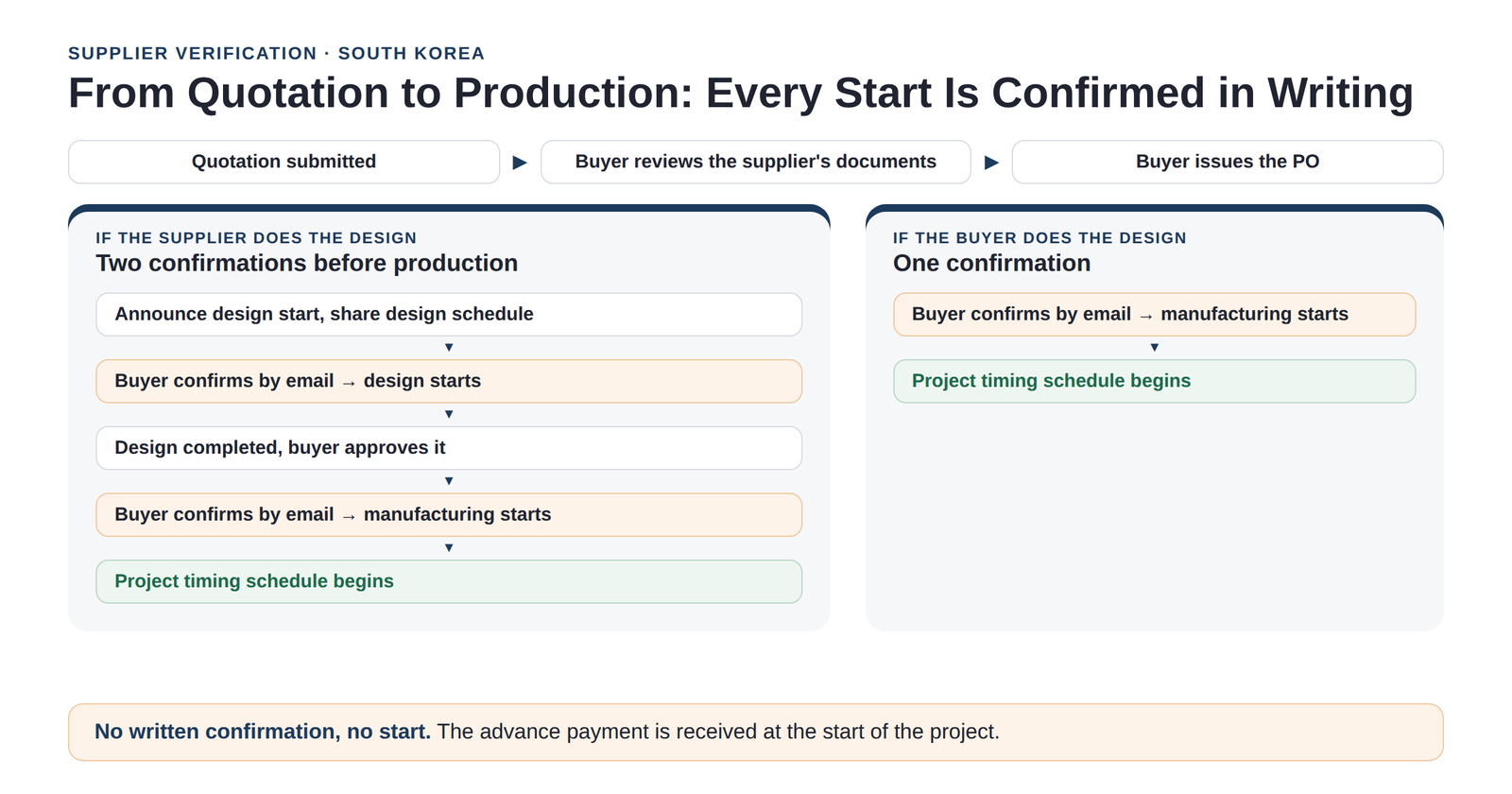
When the buyer has reviewed these documents and is satisfied, the buyer issues a purchase order (PO). The PO is the formal start of the commitment, but the work does not begin until each step is confirmed in writing.
If the buyer has entrusted the design to the supplier, the supplier first tells the buyer that the design stage is about to begin, shares the schedule, and prepares a timing schedule for the design work. The supplier then emails the buyer to say it is ready to start and asks the buyer to confirm. Design begins only after the buyer’s confirmation email arrives.
When the design is finished, the buyer’s design engineer or other responsible person reviews it. Once the design is approved, the supplier again waits for a confirmation email before manufacturing starts. From that point, the project timing schedule takes over as the working tool for the rest of the project.
If the buyer handles the design, the sequence is shorter. After the PO, the supplier waits for the buyer’s confirmation email before manufacturing begins.
This rule is not a formality. In many projects, the advance payment is received at the start, so the supplier should never begin work without the buyer’s written confirmation. The same email protects both sides: the buyer knows exactly when the project has started, and the supplier knows the buyer is ready.
What this means for buyers
A supplier’s quotation shows its price. These documents show its way of working. Before you place a PO with a Korean manufacturer, make sure you have seen them, and make sure they match what the RFQ asked for. If a supplier says only that its own standard is fine, treat that as a warning sign. A reliable supplier shows the comparison and waits for your confirmation.
If you would like help reviewing a supplier’s document package, see our Services or get in touch.
Written by Cheolho Shim, founder of KoreaLiaisonPM in Busan. Twenty years in automotive OEM supply chains and mining infrastructure projects. About me →
Leave a Reply