Part of an ongoing series on how Korean sourcing and manufacturing projects actually run, told through real projects rather than general advice.
Why mines need wash systems at all
If you’ve never worked in mining, this might sound like an odd thing to build a business around. Here’s the short version.
Most open-pit mines in places like Australia, China, and Kazakhstan run enormous haul trucks — machines that can cost well over a million dollars each. Once these trucks start hauling ore, the undercarriage and chassis are exposed to constant abrasive buildup, and components corrode and wear out far faster than they should. A proper wash system — high-pressure underchassis spinners, wash arches for the upper body, a drying stage, and a full water reclamation and filtration loop — extends the life of that equipment dramatically. Compared to replacing a haul truck, the cost of a wash system is easy to justify once a mine operator actually sees the math. That’s the market this project sat in.
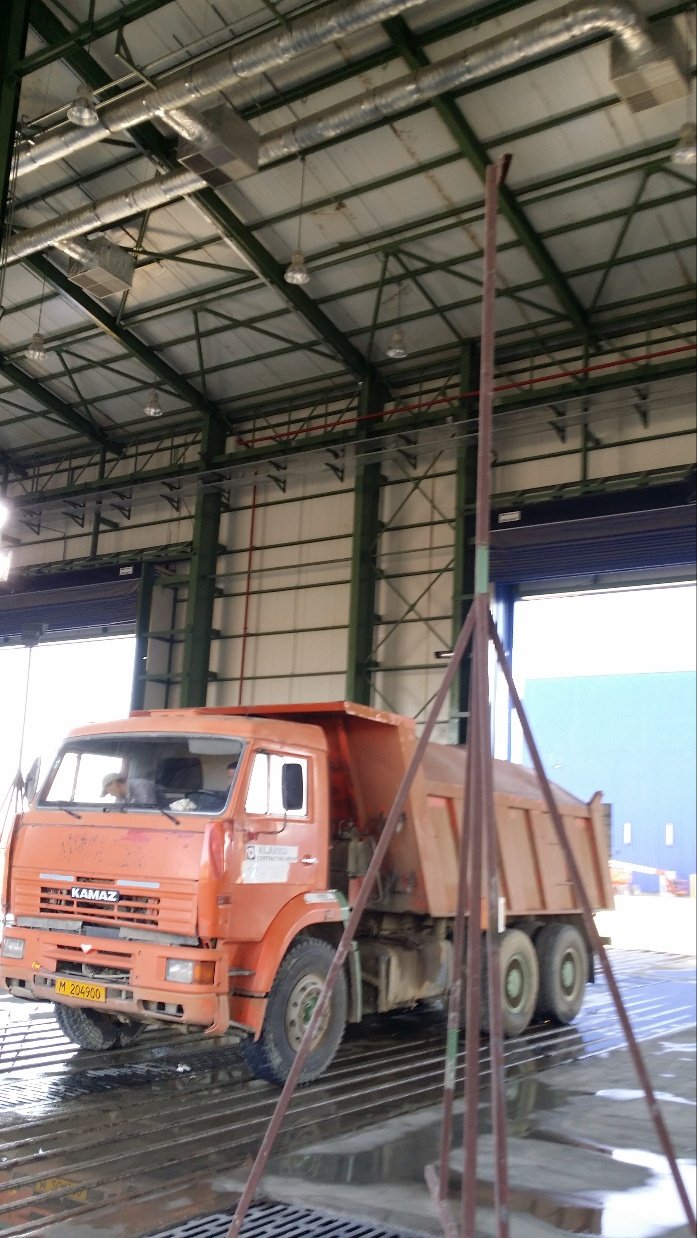
On site at Bozshakol, Kazakhstan, during the design verification visit.
The client chain looked like this: Kazakhmys (the mine operator in Kazakhstan) engaged AMMS Group, an Australian engineering company, for the wash system design and supply. AMMS in turn brought the project to JAM, a Korean–Australian joint venture, to handle the full scope — design, manufacturing, and delivery of the entire wash system. I managed the project on JAM’s side.
The scope covered the full system: three large custom pumps (developed with Wilo specifically for this application, since nothing off-the-shelf fit), motors, general drainage pumps, the complete piping run for the wash bay, main and auxiliary electrical panels (shipped pre-installed inside a container), multiple wash-water cannons, mounting plates for all equipment, and the full water treatment and filtration system including sludge filtration.
Design alone took about two months. From kickoff to a confirmed, signed-off design from Kazakhmys took roughly four months total. Manufacturing and production took around nine months, including shipping. Once the finished equipment left port, ocean transit plus customs clearance in Kazakhstan and inland trucking to the mine added another 40–50 days.
The drawing problem nobody expected
A roadside stop along the way to the mine — a reminder of just how remote these sites can be.
Before finalizing our own design, we visited the actual site — Bozshakol mine — to verify the space where the wash system would be installed. This turned out to be the right call, because the reference drawings that had been passed down the chain (Kazakhmys → AMMS → JAM) didn’t match the real site at all.
What happened was that AMMS had been paid by Kazakhmys to produce site drawings, but those drawings were unusable. So on top of our own contracted scope — the full wash system design, piping, and electrical panel layout — we ended up redrawing AMMS’s site foundation drawings from scratch, with no additional payment, simply because the project needed it to move forward and we’d already committed to delivering.
If we hadn’t insisted on the site visit early on, we would have designed the entire system around drawings that didn’t reflect reality. The equipment likely wouldn’t have fit on installation, the claims and rework costs would have been significant, and it would have damaged the trust we’d built with everyone in the chain. Catching this early, before a single part was fabricated, is the kind of thing that never shows up in a contract but ends up mattering more than almost anything else.
Running the schedule
Once Kazakhmys gave final written confirmation on the design, I notified all the subcontractors that they could begin — with a commitment that material costs would be wired to them within the week, so they could move without waiting on paperwork. Internally, JAM built a timing schedule and distributed it to every vendor involved.
From there, it’s the same weekly-visit, remarks-column discipline I’ve described in earlier posts: track progress by vendor, log any issues in a remarks field, and only escalate the ones that actually affect the client’s delivery date rather than reporting every minor hiccup. I also try to physically visit factories once or twice a week when possible, even though vendors are often spread across different regions. It’s not always easy, but it matters — specs that look identical on paper (Korean standards vs. Australian vs. Kazakhstani, even under a shared reference like ASTM) get interpreted slightly differently by welders and fabricators who default to whatever they’re used to. Regular site visits are really the only way to catch that drift before it becomes a real problem.
Three days before the audit
Everything else on this project went smoothly. Then, three days before Kazakhmys’s own inspection firm was scheduled to audit the completed system, a problem surfaced in the piping and electrical work — from a vendor that had shown no warning signs at all up to that point.
We split into two teams — one on the piping issue, one on electrical, including myself — and worked through it around the clock for three days. Nobody went home. We kept both the client and the inspection firm informed throughout, and asked for a short grace window in case we needed it. In the end, both issues were resolved in time, and the system passed audit on schedule with no delay to the delivery date.
Because the electrical panel is the system’s core — if it fails, nothing runs — I wasn’t comfortable simply handing it off after the fix. Normally, sending an engineer on-site for installation support is a paid service the client requests separately. For this project, I chose to cover that cost myself and sent one of our engineers along with the panel vendor’s engineer to be present for the actual installation, train the local team, and run the first startup themselves. Both engineers told me afterward it was one of the more rewarding parts of the project.
The client’s reaction to all of this was, understandably, very positive. We’d already fixed a serious problem three days before their own audit without missing the deadline, and then covered the cost of sending an engineer on-site ourselves rather than billing for it. That combination did more for the relationship than anything I could have said in a meeting.
Eight months later, Kazakhmys came back to us directly for a second wash system project — this time at their Aktogay mine, and this time with no AMMS Group in between. That, more than anything else, is what tells me the first project worked the way it was supposed to.
Getting paid, and getting it shipped
Once the audit was behind us, there was still the commercial side to manage. This was the first time JAM and Kazakhmys had worked together directly for payment — funds flowed straight from Kazakhmys to JAM, bypassing AMMS in the payment chain — so there was naturally some caution on both sides. The interim payment came through about a week to ten days after the audit, once we’d shared photo documentation of the equipment in storage and confirmed the final stages of production. Vendors are waiting on that money too, so managing both sides of that gap is honestly one of the less glamorous parts of being a PM.
With the interim payment in, we moved into final assembly and packaging — all built to the design drawings, with the piping shipped disassembled for site assembly. Packaging planning starts about a month before shipment, coordinated with both the packing contractor and the freight forwarder so containers are booked to match the actual crate dimensions; large equipment leaves very little room for error here. On packing day, every container was photographed as it was loaded, sealed, and photographed again after sealing. Those photos went to the client along with the shipping documents, and once they confirmed everything, the final balance was paid and the containers shipped.
After that, the last piece was putting together the technical documentation package — approved final drawings, assembly instructions per piece of equipment, operating manuals, and a troubleshooting guide — bound into physical manuals and mailed to the client. As mentioned above, we also sent an engineer for on-site installation support on this one.
What I’d want a buyer to take from this
None of this went perfectly. The drawings were wrong, a vendor had a last-minute problem nobody saw coming, and the payment structure was new territory for everyone involved. What actually got the project through wasn’t avoiding those problems — it was catching the drawing issue before fabrication started, keeping the client informed rather than hiding the panel issue, and being willing to eat a cost (redrawing AMMS’s site drawings, sending an engineer without extra billing) when it protected the outcome. That’s really the whole approach — and Aktogay, eight months later, was the proof it worked.
This is part of an ongoing series on Korean manufacturing and sourcing project management. Previous posts cover timing schedule management, handling production problems, packaging and shipping, technical documentation, and engineer dispatch as general processes — this one walks through how they actually played out on a real project. For an earlier chapter in this story — how I first became a supplier to a major automotive alliance and navigated a major quality crisis overseas — see “Becoming a Global Automaker Supplier.”
Leave a Reply