
Tag: quality management

  • Supplier Verification Checklist: Two Red Flags Most Buyers Miss

    Supplier Verification Checklist: Two Red Flags Most Buyers Miss

    A supplier checklist is a good place to start. It tells you what to look at. But a supplier can pass a checklist and still cause trouble once the project begins. In my experience, the risk tends to hide in two places that a checklist rarely captures: what happens after an audit finds a problem, and how the supplier communicates with you.

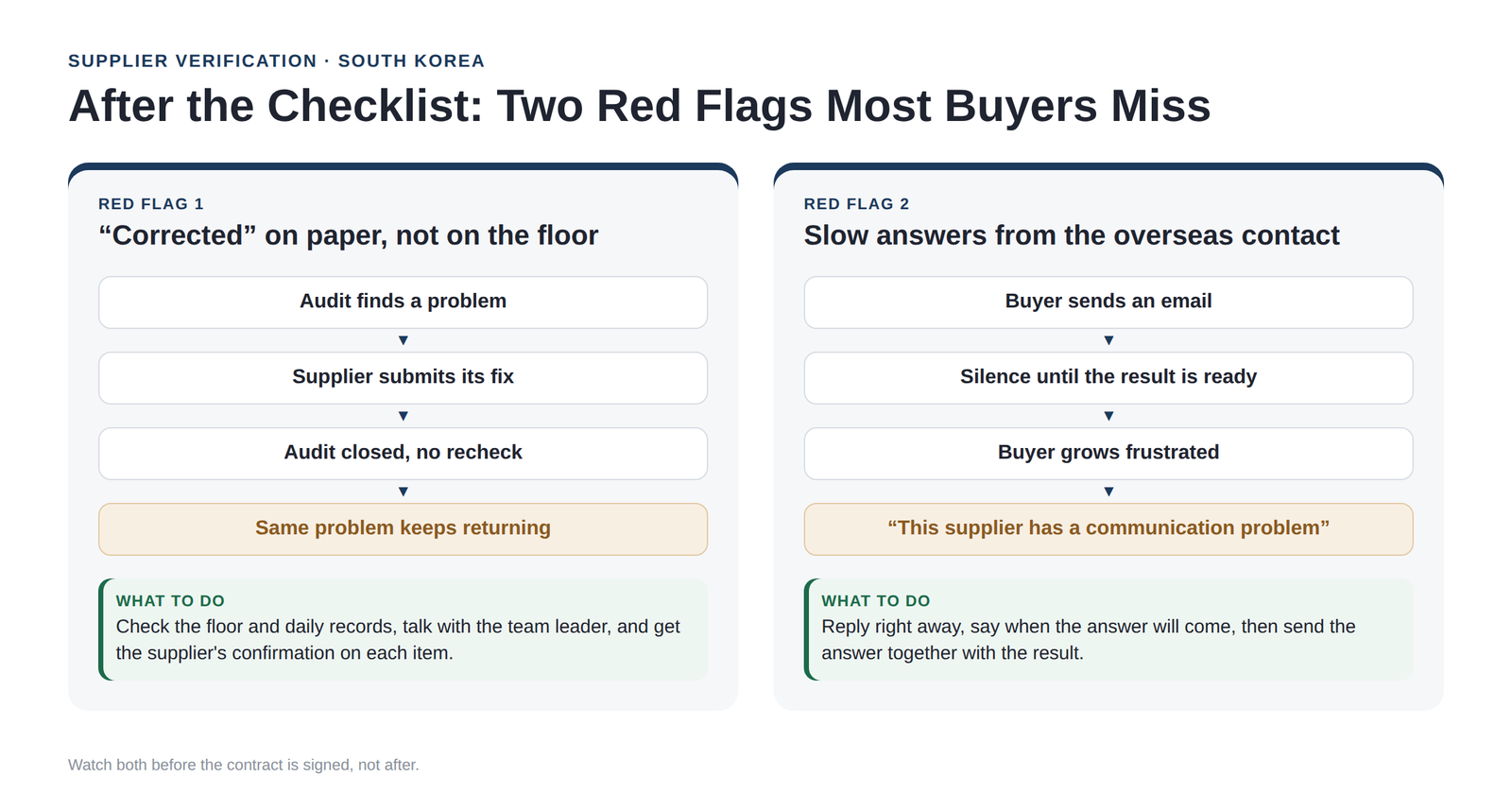
    Red flag 1: “Corrected” on paper, but the problems keep coming back

    Here is how many audits end. The auditor goes through the supplier with a checklist, records the problem areas, and reports them to the company. The company fixes or improves those items and submits its response to the auditor. In many cases, that is where it stops.

    Ideally, the auditor would visit once more to confirm that the improvements actually reached the shop floor. Some do. But often the auditor takes the company at its word, decides the problem has been resolved, and closes the audit.

    The difficulty is that even a real improvement is hard to judge from a document. The auditor may not know the process well enough technically to tell whether the fix addresses the true cause. And no one outside the company can be sure whether the change was made from the right point of view: one that solves the problem for the buyer, or one that merely closes the finding. Buyers then end up asking the same question: we were told this was improved, so why does the same problem keep happening?

    This is where problems most often arise, so it deserves close attention:

    • Do not treat a submitted corrective response as proof. Read what exactly was changed and why.
    • Check whether the change shows up on the floor and in the daily records, not only in a revised document.
    • Spend real time talking with the supplier’s responsible team leader. Those conversations often reveal whether the team understands the cause of the problem.
    • Get the supplier’s confirmation on each corrected item before you rely on it.

    Realistically, an audit cannot run for days on end. That is exactly why the time you do have should go to the items that failed, and to confirming that the fix is real.

    Red flag 2: Slow answers from the overseas contact

    These days, even small and mid-sized Korean manufacturers rarely have a serious English problem. The more common risk is a person in the overseas contact role who has little experience with overseas buyers. If they do not understand how overseas buyers think and work, the project can become difficult in unexpected ways.

    The best remedy is fast feedback. When I handled overseas sales, I would read a buyer’s email in the morning and reply right away: we have received it, and after meeting with the team we will get back to you by a specific date. Then I held the meeting and sent the answer together with the result. The buyer sees that someone is paying attention to their email, and when the result arrives, concludes that this contact can be trusted.

    The common pattern is the opposite. The contact waits until the result is ready and only then replies. In the meantime, the buyer hears nothing and grows frustrated. After a few rounds of this, the buyer decides that the supplier has a communication problem.

    Real communication is simple: read the email, make a judgment, reply quickly, then gather the answer with the relevant team and send it. When you evaluate a supplier, watch how fast and how clearly the overseas contact responds before the contract is signed, not after.

    Where the checklist fits

    A checklist is still worth using. It organizes what to look at across documents, on-site checks, finances, and communication. My free Supplier Verification Checklist covers twelve items across those areas and gives you a quick read on how well screened a supplier is.

    The two red flags above are what I look for beyond the checklist when I audit and manage suppliers. To see how an on-site audit works, read What a Manufacturing Process Audit in South Korea Actually Looks Like. To see how I combine sourcing, audit, and project management, visit the Services page.

    For a real project where schedule and quality were tested under pressure, read the case study Building a Truck Wash System for a Kazakhstan Copper Mine, or see why the same client came back for a second project.


    Written by Cheolho Shim, founder of KoreaLiaisonPM in Busan. Twenty years in automotive OEM supply chains and mining infrastructure projects. About me →
  • What a Manufacturing Process Audit in South Korea Actually Looks Like

    What a Manufacturing Process Audit in South Korea Actually Looks Like

    Many overseas buyers hear “we’ll audit the factory” and picture a clipboard and a quick tour. In practice, a proper process audit in Korea is a structured comparison between what the factory says it does and what actually happens on the shop floor. Here is how it works, based on the audits I have run on Korean suppliers.

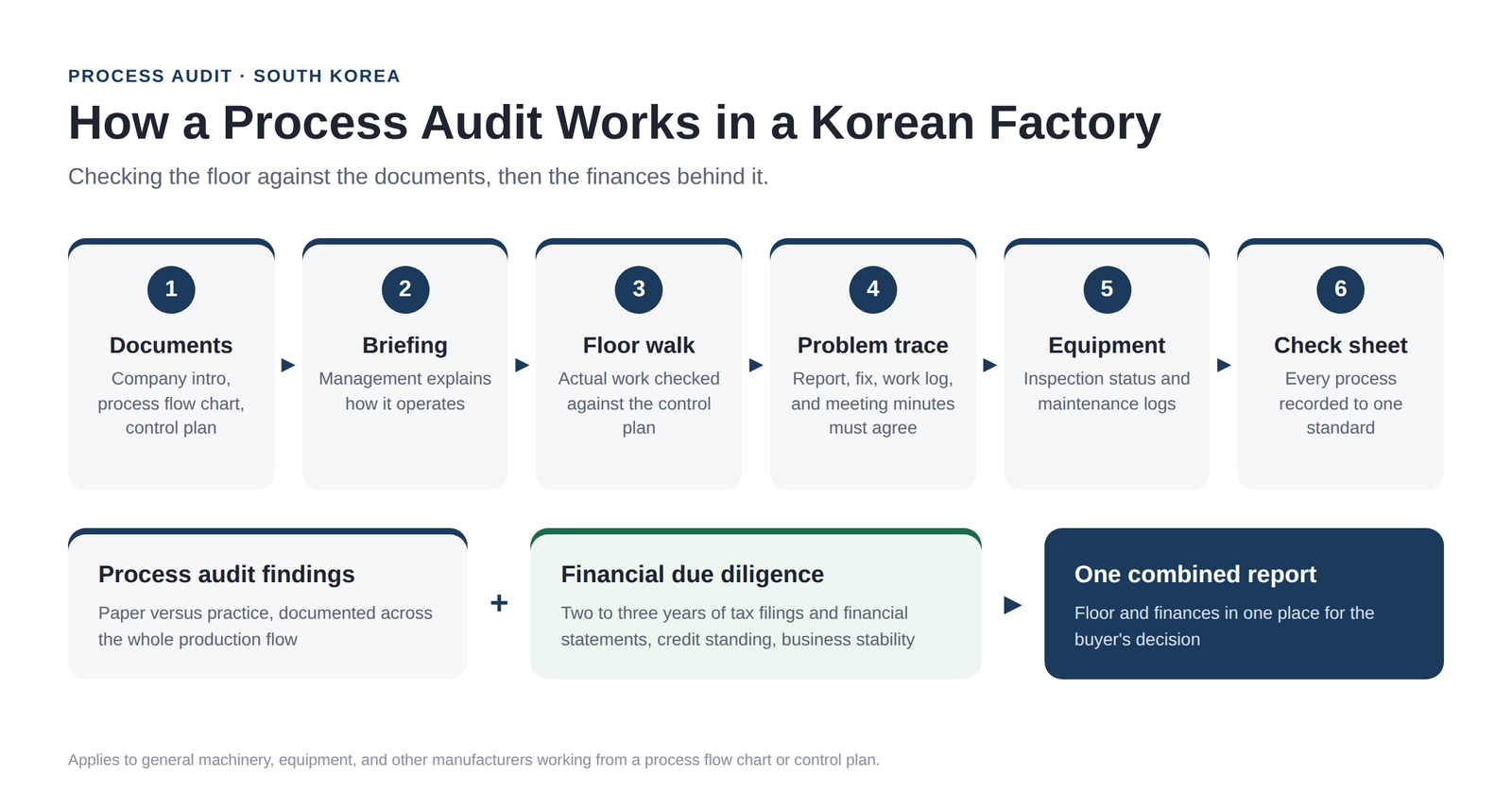
    Step 1: Documents come first

    Before anyone visits the site, I request the supplier’s core documents: the company introduction, the manufacturing process flow chart, and the control plan. The control plan is the key one. It defines, process by process, what is checked, how often, and what happens when something goes wrong. Everything on the floor is measured against it.

    Step 2: The visit begins with the company, not the factory

    On audit day, the supplier first presents the company: what they make, who they supply, and how they are organized. This is not small talk. It tells me how the management understands its own operation, and it sets up the questions I will ask during the walk-through.

    Step 3: Walking the floor with the control plan in hand

    Then we walk the actual production line, with the process flow chart and the control plan in hand. I carry my own check sheet too, but in practice the two are very similar, because the check sheet is built on the control plan’s standards. The core question at every station is simple: is the work being done the way the documents say it is?

    Step 4: Following a problem all the way through

    This is where an audit gets real. I do not stop at “is there a procedure.” I follow what happens when something goes wrong:

    • Was the problem reported to the people above the operator?
    • After the report, was the process actually corrected?
    • Does the correction show up in the daily work log?
    • Do the work log and the meeting minutes from the problem meeting tell the same story?
    • On the floor today, has the problem really been fixed?

    A supplier can have a perfect procedure on paper. If the work log says one thing and the meeting minutes say another, or if the fix never reached the line, that gap is exactly what the audit exists to find.

    Step 5: Equipment and maintenance records

    At each process I also check the machine in use: has it been inspected, and is there a maintenance log to prove it? Each item goes on the check sheet, one by one. A machine that runs well today but has no inspection record is a risk, because the next breakdown will have no history to learn from.

    Step 6: Recording everything on the check sheet

    By the end of the walk, every process has been checked against the same standard and recorded. The result is not an impression, it is a documented comparison of paper versus practice for the whole production flow.

    A process audit alone is not enough: financial due diligence and the report

    Even a well-run floor can sit inside a financially fragile company, and that risk can surface in the middle of your project. So I pair the process audit with financial due diligence. I analyze the supplier’s tax filings and financial statements for the last two to three years, along with credit standing and business stability, to confirm you are getting not just a capable factory but a stable one.

    The on-site audit findings and the financial due diligence results are combined into a single report for the buyer. You see the paper-versus-practice comparison, what was observed on the floor, and the supplier’s financial position in one place, and can make your decision from there.

    Which suppliers does this apply to?

    This approach applies to general machinery and equipment manufacturers, and to any manufacturer that works from a process flow chart or control plan. The industry changes, but the logic of the audit does not: check the floor against the documents.

    What this means for buyers

    If a supplier can show you consistent documents, a floor that matches them, a clear trail from problem to correction, and a stable financial position, you are looking at a supplier that manages itself. If not, you want to know before the purchase order, not after.

    For how this fits into a full supplier evaluation, read Sourcing Korean Suppliers: Two Paths for Overseas Buyers. To see how I combine sourcing, audit, and project management, visit the Services page.

    For a real project where these checks mattered, read the case study Building a Truck Wash System for a Kazakhstan Copper Mine, where wrong site drawings were caught before fabrication and the system passed the client’s audit on schedule.


    Written by Cheolho Shim, founder of KoreaLiaisonPM in Busan. Twenty years in automotive OEM supply chains and mining infrastructure projects. About me →

  • The Second Chance — How One Project Led to Another, Across Europe

    The Second Chance — How One Project Led to Another, Across Europe

    Part of an ongoing series on how Korean sourcing and manufacturing projects actually run. The last post covered a quality crisis on my first engine program with a major automotive alliance and the three weeks I spent resolving it overseas. Handling that crisis quickly and fairly turned out to open the door to a second project almost immediately.

    A second bid, built on trust

    Once we’d resolved the earlier quality issue in a way the customer could genuinely accept, a second bidding opportunity came our way. We submitted a quote through the normal process, went through technical meetings at the automaker’s overseas headquarters, and after a final round of price negotiation, won the business over several competing suppliers.

    This engine was different from the first — a compact diesel platform used not just by this alliance but across several automakers’ small-car lineups. Volume started in the hundreds of thousands of units annually, with real potential to climb into the millions as adoption spread to additional brands. For our company, this was a major program, and headquarters had high expectations for it too. Unlike the first project, this engine wasn’t assembled at the same plant as before — it was built at a different plant, further south in Europe, which meant our prototype deliveries shifted there as well.

    During early prototype development, I was overseas often, and the customer’s team visited our factory just as frequently — checking that our actual production process matched what we’d submitted on paper, and given our recent history with a quality escape, auditing our containment procedures in far more detail than before.

    Video calls every other day, for months

    Normally, you’d coordinate logistics with a purchasing contact at headquarters and handle technical questions separately with the engineering team. This project ran differently. The customer assigned a dedicated PM, and that person and I handled nearly everything together, from development kickoff onward — an unusual setup.

    We worked from a shared requirements sheet and held video calls with each other roughly every other day. I’d send over whatever documentation we owed by email, we’d update the sheet together, and cross off anything that wasn’t realistic or necessary for us to produce. From the start of development through prototype delivery and engine testing, this went on for months — two or three video calls a week, with in-person visits to headquarters whenever needed. I kept our internal teams updated on progress throughout.

    Somewhere in the middle of those months, I started half-joking with the PM that once development wrapped and I made it to headquarters, they owed me pizza and beer.

    An unexpected dinner invitation

    Once development testing wrapped up cleanly and I traveled to headquarters for final wrap-up work, something I hadn’t expected happened. A senior executive personally invited me to dinner, thanking me for the work — it turned out my running joke with the PM had made its way up the chain.

    As it happened, our company’s CEO’s son (a director at the time) was also visiting headquarters that day for an unrelated event, but the dinner invitation had only been extended to me. When I mentioned the situation, the executive asked whether he could join too, and after checking with the PM, got the go-ahead. We were treated to a genuinely excellent dinner at a fine restaurant, and at the table, the executive told me directly that the development process couldn’t have been easy, and thanked me for seeing it through.

    Hearing that in the moment meant more than I expected — being recognized like that is rare in a supplier-customer relationship. It’s the kind of acknowledgment that can be hard to get even internally, no matter how much you deliver, so hearing it from the customer instead made the whole stretch feel worth it.

    Prototypes, and a trip back overseas

    Once prototypes shipped to the new plant, the PM asked me to come see the engine assembly in person. The same executive from headquarters said he’d be there too. Our CEO asked that his son (a managing director by then) come along as well, so the two of us flew in, took a train to the plant, stayed overnight, and toured the assembly and testing process the next day. That evening we had dinner with the PM, the executive, and the CEO’s son, talked through a range of things, and flew home with what we needed to wrap things up.

    A minor defect, and a solo trip back

    Some time later, once things were running smoothly, a defect turned up in a batch of around 1,000 units — nothing close to the severity of the earlier crisis, thankfully. This time I went alone. I met with the plant’s quality manager, reviewed the flagged units, and with their help brought in two sorting staff to work through them together. (Plants like this typically keep a pre-arranged sorting contractor on standby for exactly this kind of situation.)

    Sorting turned up around 450 confirmed defective units; the rest were cleared for use. I asked our team to ship the remaining volume by sea rather than air, since this situation wasn’t urgent enough to justify the added cost. I wrapped things up and flew home.

    What both projects taught me

    Both projects, in their own way, also made clear the limits of working at a small or mid-sized supplier — one person ending up responsible for technical sales, development, quality response, and even production line planning, all at once. But within those limits, the approach stayed the same: face the problem directly, and build the relationship on trust rather than excuses. That’s the principle that’s carried through the rest of my career since.


    This is part of an ongoing series on Korean manufacturing and sourcing project management.


    Written by Cheolho Shim, founder of KoreaLiaisonPM in Busan. Twenty years in automotive OEM supply chains and mining infrastructure projects. About me →