
Tag: manufacturing verification

  • Supplier Verification Checklist: Two Red Flags Most Buyers Miss

    Supplier Verification Checklist: Two Red Flags Most Buyers Miss

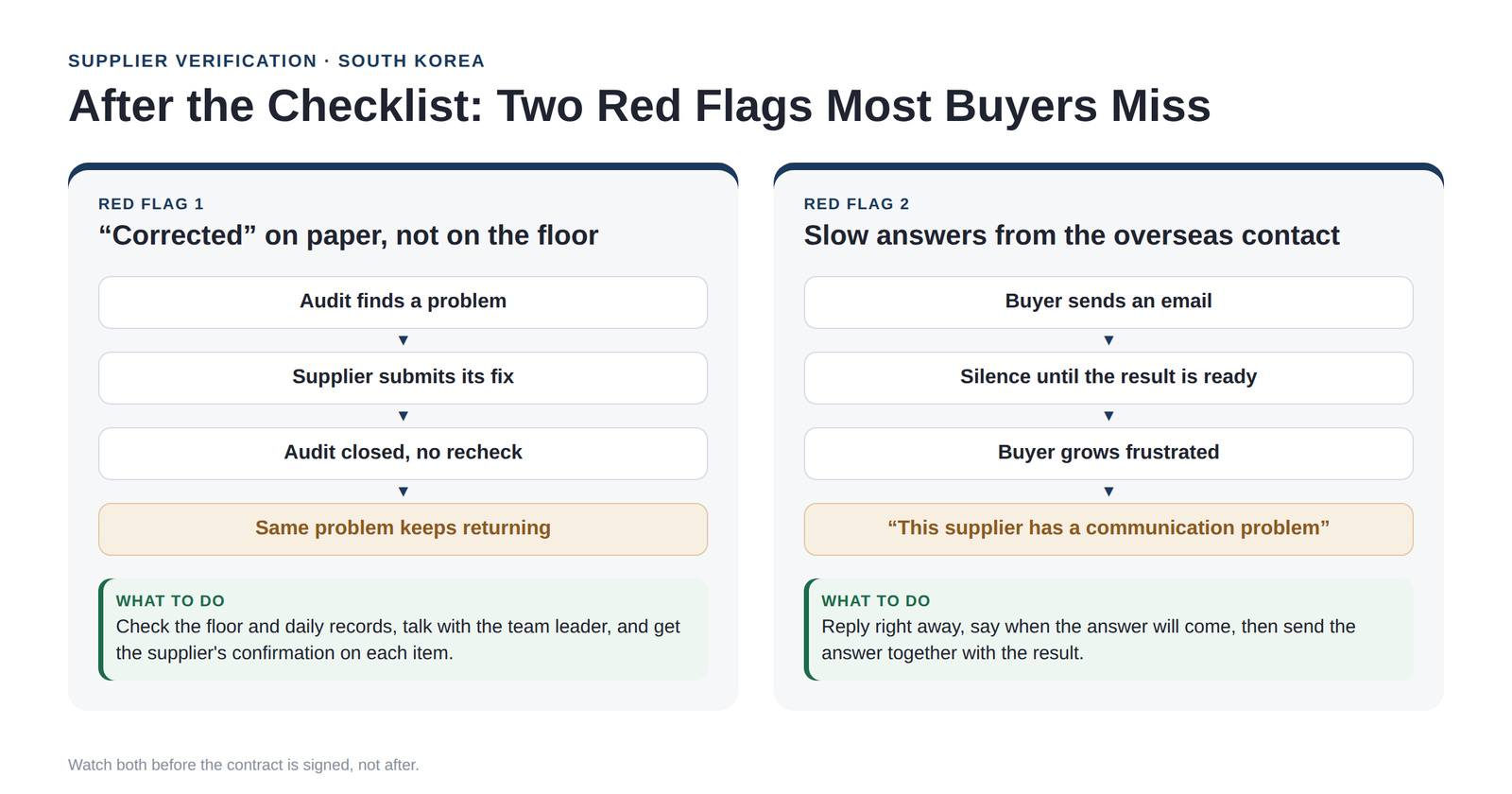
    A supplier checklist is a good place to start. It tells you what to look at. But a supplier can pass a checklist and still cause trouble once the project begins. In my experience, the risk tends to hide in two places that a checklist rarely captures: what happens after an audit finds a problem, and how the supplier communicates with you.

    Red flag 1: “Corrected” on paper, but the problems keep coming back

    Here is how many audits end. The auditor goes through the supplier with a checklist, records the problem areas, and reports them to the company. The company fixes or improves those items and submits its response to the auditor. In many cases, that is where it stops.

    Ideally, the auditor would visit once more to confirm that the improvements actually reached the shop floor. Some do. But often the auditor takes the company at its word, decides the problem has been resolved, and closes the audit.

    The difficulty is that even a real improvement is hard to judge from a document. The auditor may not know the process well enough technically to tell whether the fix addresses the true cause. And no one outside the company can be sure whether the change was made from the right point of view: one that solves the problem for the buyer, or one that merely closes the finding. Buyers then end up asking the same question: we were told this was improved, so why does the same problem keep happening?

    This is where problems most often arise, so it deserves close attention:

    • Do not treat a submitted corrective response as proof. Read what exactly was changed and why.
    • Check whether the change shows up on the floor and in the daily records, not only in a revised document.
    • Spend real time talking with the supplier’s responsible team leader. Those conversations often reveal whether the team understands the cause of the problem.
    • Get the supplier’s confirmation on each corrected item before you rely on it.

    Realistically, an audit cannot run for days on end. That is exactly why the time you do have should go to the items that failed, and to confirming that the fix is real.

    Red flag 2: Slow answers from the overseas contact

    These days, even small and mid-sized Korean manufacturers rarely have a serious English problem. The more common risk is a person in the overseas contact role who has little experience with overseas buyers. If they do not understand how overseas buyers think and work, the project can become difficult in unexpected ways.

    The best remedy is fast feedback. When I handled overseas sales, I would read a buyer’s email in the morning and reply right away: we have received it, and after meeting with the team we will get back to you by a specific date. Then I held the meeting and sent the answer together with the result. The buyer sees that someone is paying attention to their email, and when the result arrives, concludes that this contact can be trusted.

    The common pattern is the opposite. The contact waits until the result is ready and only then replies. In the meantime, the buyer hears nothing and grows frustrated. After a few rounds of this, the buyer decides that the supplier has a communication problem.

    Real communication is simple: read the email, make a judgment, reply quickly, then gather the answer with the relevant team and send it. When you evaluate a supplier, watch how fast and how clearly the overseas contact responds before the contract is signed, not after.

    Where the checklist fits

    A checklist is still worth using. It organizes what to look at across documents, on-site checks, finances, and communication. My free Supplier Verification Checklist covers twelve items across those areas and gives you a quick read on how well screened a supplier is.

    The two red flags above are what I look for beyond the checklist when I audit and manage suppliers. To see how an on-site audit works, read What a Manufacturing Process Audit in South Korea Actually Looks Like. To see how I combine sourcing, audit, and project management, visit the Services page.
  • What a Manufacturing Process Audit in South Korea Actually Looks Like

    What a Manufacturing Process Audit in South Korea Actually Looks Like

    Many overseas buyers hear “we’ll audit the factory” and picture a clipboard and a quick tour. In practice, a proper process audit in Korea is a structured comparison between what the factory says it does and what actually happens on the shop floor. Here is how it works, based on the audits I have run on Korean suppliers.

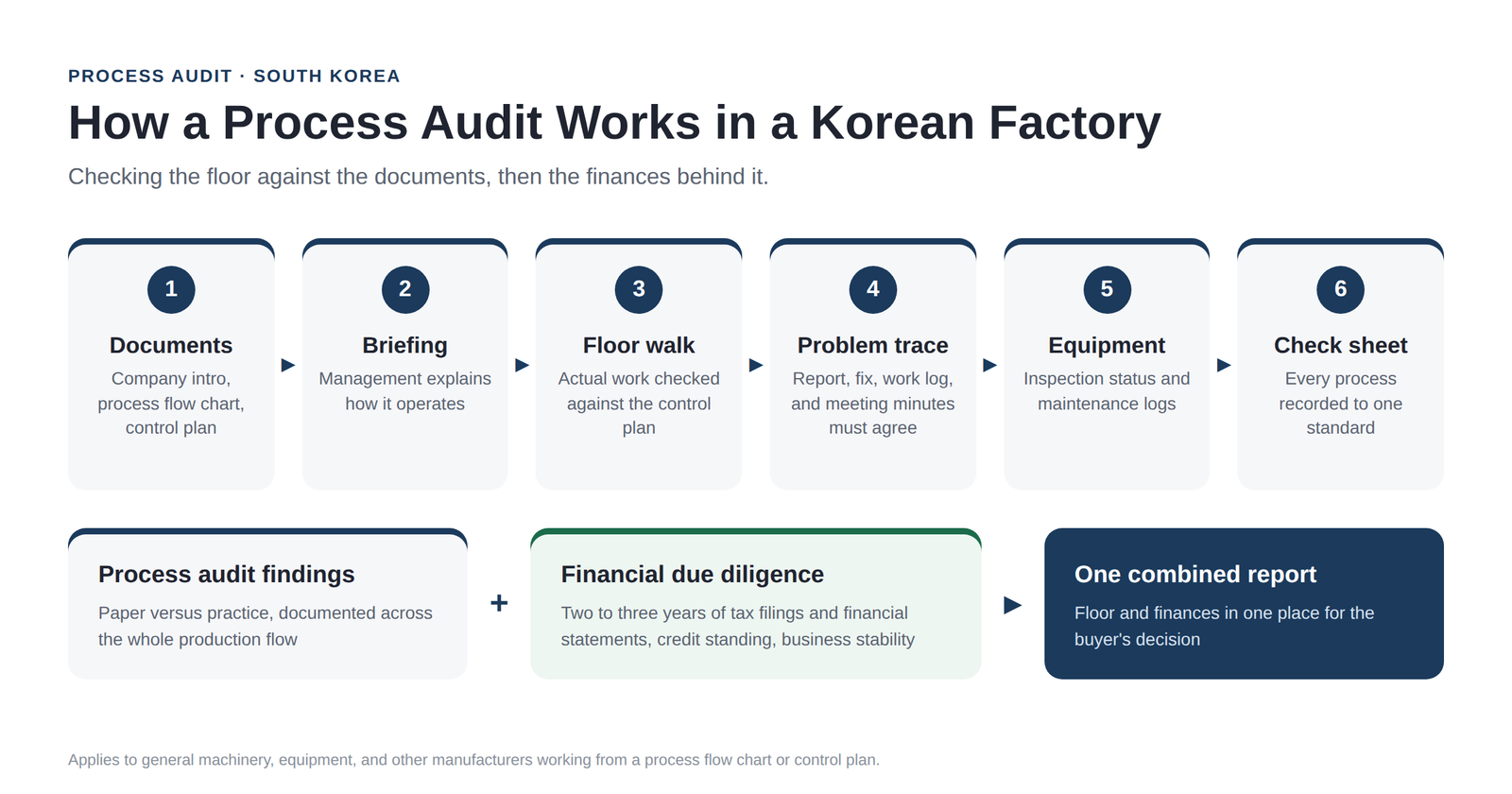
    Step 1: Documents come first

    Before anyone visits the site, I request the supplier’s core documents: the company introduction, the manufacturing process flow chart, and the control plan. The control plan is the key one. It defines, process by process, what is checked, how often, and what happens when something goes wrong. Everything on the floor is measured against it.

    Step 2: The visit begins with the company, not the factory

    On audit day, the supplier first presents the company: what they make, who they supply, and how they are organized. This is not small talk. It tells me how the management understands its own operation, and it sets up the questions I will ask during the walk-through.

    Step 3: Walking the floor with the control plan in hand

    Then we walk the actual production line, with the process flow chart and the control plan in hand. I carry my own check sheet too, but in practice the two are very similar, because the check sheet is built on the control plan’s standards. The core question at every station is simple: is the work being done the way the documents say it is?

    Step 4: Following a problem all the way through

    This is where an audit gets real. I do not stop at “is there a procedure.” I follow what happens when something goes wrong:

    • Was the problem reported to the people above the operator?
    • After the report, was the process actually corrected?
    • Does the correction show up in the daily work log?
    • Do the work log and the meeting minutes from the problem meeting tell the same story?
    • On the floor today, has the problem really been fixed?

    A supplier can have a perfect procedure on paper. If the work log says one thing and the meeting minutes say another, or if the fix never reached the line, that gap is exactly what the audit exists to find.

    Step 5: Equipment and maintenance records

    At each process I also check the machine in use: has it been inspected, and is there a maintenance log to prove it? Each item goes on the check sheet, one by one. A machine that runs well today but has no inspection record is a risk, because the next breakdown will have no history to learn from.

    Step 6: Recording everything on the check sheet

    By the end of the walk, every process has been checked against the same standard and recorded. The result is not an impression, it is a documented comparison of paper versus practice for the whole production flow.

    A process audit alone is not enough: financial due diligence and the report

    Even a well-run floor can sit inside a financially fragile company, and that risk can surface in the middle of your project. So I pair the process audit with financial due diligence. I analyze the supplier’s tax filings and financial statements for the last two to three years, along with credit standing and business stability, to confirm you are getting not just a capable factory but a stable one.

    The on-site audit findings and the financial due diligence results are combined into a single report for the buyer. You see the paper-versus-practice comparison, what was observed on the floor, and the supplier’s financial position in one place, and can make your decision from there.

    Which suppliers does this apply to?

    This approach applies to general machinery and equipment manufacturers, and to any manufacturer that works from a process flow chart or control plan. The industry changes, but the logic of the audit does not: check the floor against the documents.

    What this means for buyers

    If a supplier can show you consistent documents, a floor that matches them, a clear trail from problem to correction, and a stable financial position, you are looking at a supplier that manages itself. If not, you want to know before the purchase order, not after.

    For how this fits into a full supplier evaluation, read Sourcing Korean Suppliers: Two Paths for Overseas Buyers. To see how I combine sourcing, audit, and project management, visit the Services page.

  • Financial Due Diligence vs. Factory Audit: Why Buyers Need Both (And Usually Only Get One)

    Financial Due Diligence vs. Factory Audit: Why Buyers Need Both (And Usually Only Get One)

    When international buyers talk about “verifying” a Korean manufacturer, there’s a standard playbook. Hire a certified audit firm in Korea, pay them, and have them visit a specific manufacturer to run a process audit.

    The process usually goes like this: the audit firm notifies the manufacturer of a visit date. The auditor shows up with a carefully prepared Quality Audit Sheet. There’s a company introduction, a cup of coffee, and then the walkthrough begins.

    I’ve been on the receiving end of this myself. During the Kazakhmys project in Kazakhstan, I went through process audits on a single day — a piping contractor in the morning, an electrical contractor in the afternoon. Two audits, back to back, in one day. That evening, I remember hosting the auditors for dinner.

    Here’s the problem. Going through a detailed audit sheet, item by item, absolutely gives a foreign buyer peace of mind. But the real effectiveness is smaller than it looks. The reason is simple: because the visit date is announced in advance, the manufacturer has every opportunity to prepare so that nothing gets flagged.

    That doesn’t make it worthless. A certified audit firm carries credibility, and the report is a convincing document for a buyer. But it isn’t a complete way to evaluate a manufacturer, because an audit is, by nature, an event that can be prepared for.

    What actually matters isn’t the one day of the audit — it’s whether, on an ordinary day, this supplier is running production according to the drawings and specifications everyone agreed to.

    Limitation #1 — An audit is a prepared event

    A scheduled audit, especially one with advance notice, is fundamentally a snapshot — and one the other side knew was coming. Tidiness, paperwork, the flow of the day’s process: all of it can be optimized for that single visit. When an auditor has to cover two suppliers in one day, as I did in Kazakhstan, there isn’t much time to dig deep into either one. No matter how thorough the checklist is, it can’t get past the fact that it’s measuring what was prepared to be shown that day.

    Limitation #2 — What an audit misses: the ordinary day

    The real question isn’t “how does the process look on audit day” — it’s “on the 361 other days, is this supplier actually producing to the confirmed drawings and specs?” A single scheduled visit can never answer that. What does is showing up unannounced, or simply visiting often enough that it stops being an “audit” and becomes routine — seeing the process as it actually runs. This is exactly what I do during active projects: regular site visits, not scheduled inspections.

    Limitation #3 — What an audit misses: financial condition

    There’s one more thing no audit sheet will ever capture — whether this company will still be standing eight months from now, when your production run is scheduled to finish.

    I spent over a decade inside automotive OEM supply chains — Hyundai-Kia, Renault-Nissan — and managed joint venture projects with global mining companies like BHP and Rio Tinto across Kazakhstan and Australia. In that world, a supplier’s cash position matters as much as its equipment list. A factory that looked flawless during a visit can be three months behind on payments to its own raw material suppliers. Brand-new machinery can be sitting on debt the company can’t actually service. A director might be running two companies and quietly draining one to keep the other afloat.

    None of that shows up on an audit sheet. None of it shows up on a factory walkthrough either.

    What financial due diligence actually catches

    This is where my background differs from most sourcing agents and audit firms you’ll find. Before I moved into project management and technical verification, I spent years on the financial consulting side, reviewing corporate financials, tax structures, and ownership issues for Korean business owners. That background changes what I look for when I evaluate a supplier.

    A basic financial check on a Korean manufacturer looks at things like:

    Corporate registration and ownership structure. Who actually owns this company? Has ownership changed recently? Is there a pattern of related companies that suggests risk is being shuffled around rather than resolved?

    Payment history and credit signals. Is the company current with its own suppliers and with tax authorities? Late payments upstream are usually the first sign of trouble — and they show up in the financial record long before they show up on the factory floor.

    Revenue concentration. Is this company dependent on one or two buyers for most of its revenue? If your order is a small fraction of their business, that’s a very different risk profile than if you represent 60% of their output and they can’t afford to lose you.

    Debt load relative to fixed assets. New equipment funded by heavy short-term debt is a different situation than the same equipment paid for in cash. Both factories look identical during a visit.

    Basic solvency indicators. Is this a steadily operating company, or one quietly restructuring, changing bank relationships, or delaying supplier payments to stay afloat?

    None of this requires access to confidential internal accounting. Much of it is available through standard corporate and credit information channels in Korea, cross-referenced against what the company tells you directly.

    Why buyers usually skip this part

    Most PM and sourcing services aren’t built to do it. They’re staffed by people with manufacturing, quality, or logistics backgrounds — exactly what you want for the factory side. But financial review is a different skill set entirely, so it’s rarely included and rarely done. Buyers either skip it, or assume the factory audit already “covers” it. It doesn’t.

    The combination that actually protects a project

    In twenty years of B2B work overseas, the projects I’ve seen go wrong rarely went wrong because a factory couldn’t run its machines. They went wrong because a supplier’s financial position collapsed mid-project, and nobody had looked closely enough, early enough, to see it coming.

    A scheduled factory audit shows you that a supplier can produce on the day they prepared for. Regular, unannounced visits show you whether they actually produce that way every day. And financial due diligence shows you whether they’ll still be standing to deliver on the date you agreed to.

    Buyers who want a real answer to “can I trust this supplier” need all three — done by someone who understands what each one is actually looking for. A pre-scheduled audit report by itself isn’t enough.


    This is part of a series on sourcing and project management in Korea, based on direct experience managing manufacturing and industrial projects across automotive and heavy industry supply chains. Next: the specific red flags I look for when evaluating a new Korean supplier.