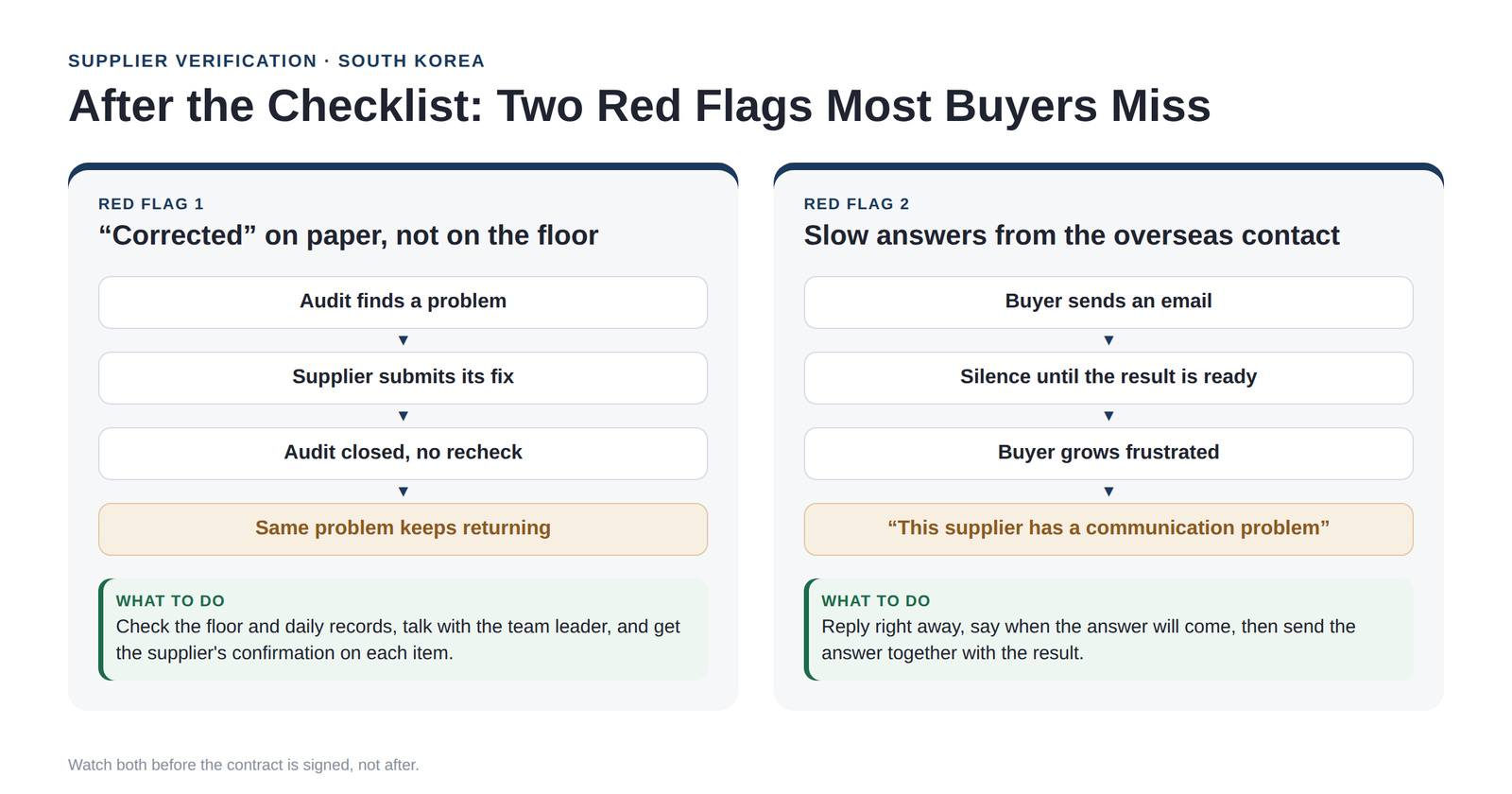
A few years ago, a buyer had already signed with a Korean supplier through a different sourcing agency. The certifications were there. The quote was reasonable. On paper, everything checked out. But a few months into production, problems from aging equipment started showing up again and again. Nothing in the paperwork had flagged it. A certificate tells you what a piece of equipment is capable of — not what it’s actually doing right now.
“How do you choose the right factory?” It’s the question I get more than any other from overseas buyers. Most people underestimate how hard this question really is. Finding a list of Korean manufacturers takes a few searches. The hard part is knowing which one is worth staking your project, your budget, your timeline — and ultimately your reputation — on.
Over the past year, I’ve written about different pieces of this process separately — the red flags I watch for, why financial due diligence matters as much as a factory audit, what actually happens once production starts. This post pulls those pieces together into the sequence I actually follow, start to finish.
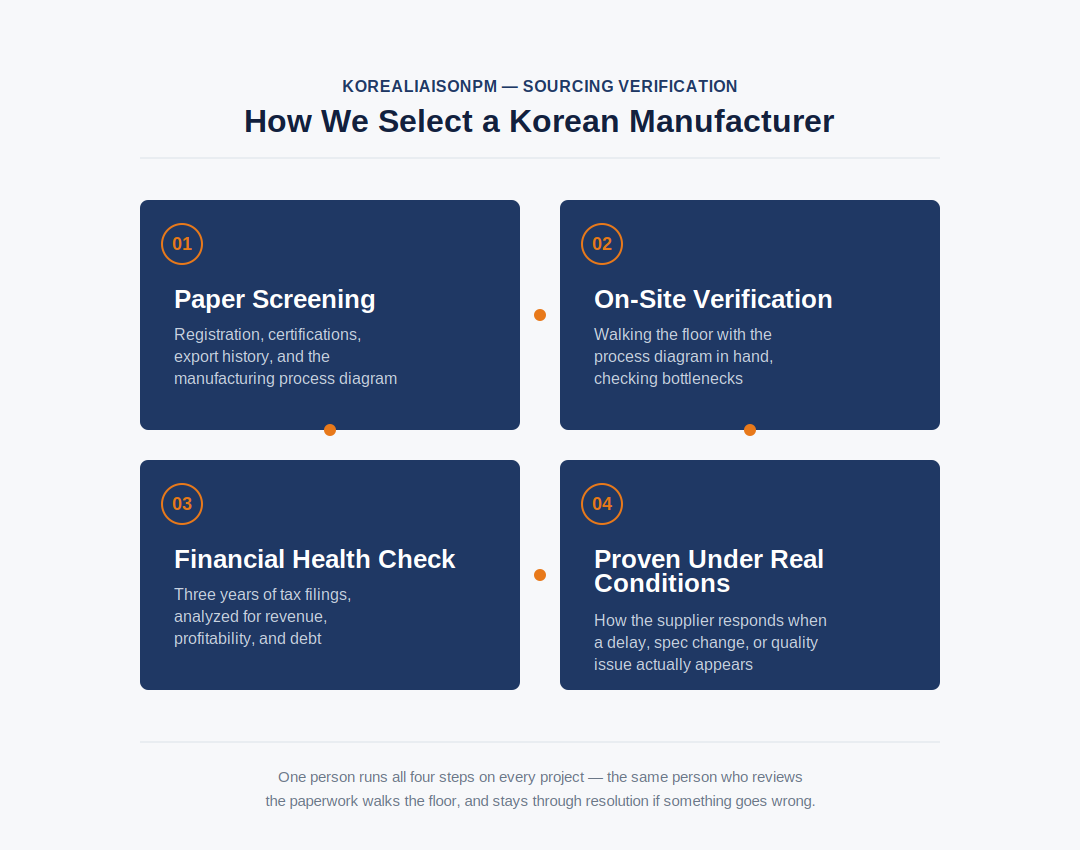
Step 1: Paper Screening
Before I visit anywhere, I start with documentation — business registration, relevant certifications (ISO and industry-specific standards), export history, and equipment lists. Beyond that, there are two things I always request: a company profile and a manufacturing process diagram.
A company profile tells you how a company describes itself. A process diagram tells you something far more useful — the actual sequence of raw material intake, processing, inspection, packaging, and shipment, along with exactly where quality checkpoints sit within that sequence. A company with no process diagram, or one that’s suspiciously oversimplified, is itself a signal — it may mean the process was never standardized, or that things get handled ad hoc, project by project.
This step looks simple, but it’s where most candidates actually get filtered out. A certification issued years before the equipment it supposedly covers was installed isn’t necessarily disqualifying on its own — but it raises a question: is this equipment still meeting that certification standard today? Any candidate that leaves that kind of question unanswered doesn’t move to the next step.
Step 2: On-Site Verification
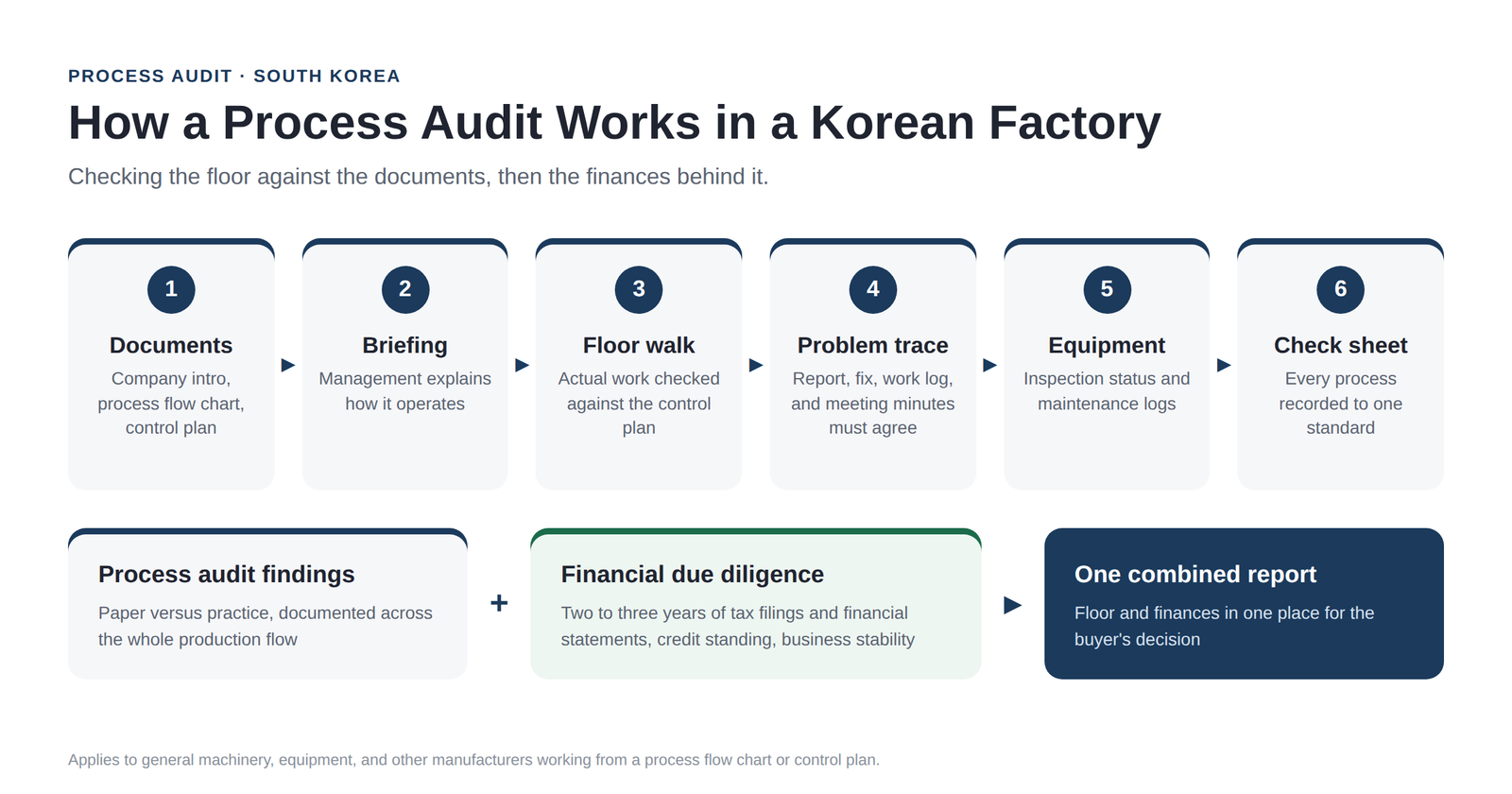
This is where paper stops being enough. [Link: 10 Red Flags I Look For] The first thing I do on-site is walk the floor with the process diagram from Step 1 in hand, following it exactly. Does the actual line layout match the documented sequence? Are inspections actually happening at the checkpoints shown on the diagram? Are there any workaround steps in practice that don’t appear on paper at all?
This is almost always where bottlenecks surface — work-in-progress piling up at a particular station, long wait times in front of certain equipment. What matters isn’t that a bottleneck exists; every factory has one somewhere. What matters is how the company handles it. Did they add capacity? Adjust shift scheduling? Or just let deadlines slip and hope no one notices? I ask directly, and I pay attention to whether the answer is specific or vague. A company that gives concrete numbers and concrete actions has clearly dealt with this problem before. A vague “we adjust as needed” is itself a warning sign.
I also check whether equipment age matches what’s on paper, and look for small inconsistencies a certificate would never reveal — a tolerance range that doesn’t match what the machine is actually producing, a maintenance log that was clearly filled in all at once, a worker on the floor who isn’t the person listed as responsible on paper. None of this shows up as a yes/no on a checklist. It only shows up when you walk the floor yourself, diagram in hand, and ask.
Step 3: Financial Health Check
A factory can look solid on the floor and still be financially unstable — and that risk never shows up in a walkthrough. [Link: Financial Due Diligence vs. Factory Audit] For this, I request the company’s tax reconciliation statements, typically covering the past three fiscal years, and analyze revenue trends, profitability, and debt structure. From that, I put together a short internal assessment of whether this is a company likely to remain stable — and reliable — two or three years into a partnership. This matters because when a supplier runs into financial trouble, quality control and delivery reliability are usually the first things to break down. Less money means fewer people, and fewer people means quality suffers next. That sequence rarely changes. Most buyers never think to ask for this — but it’s often the difference between a supplier who delivers once and one who delivers for years.
Step 4: Proving It Under Real Conditions
Verification doesn’t stop once a supplier is selected. [Link: Case Study: Kazakhstan Copper Mine] [Link: Case Study: Aktogay] The real test comes when something goes wrong — a delayed shipment, a quality issue, a spec change mid-production. [Link: What Happens After Equipment Is Finished] That’s when a supplier’s real character shows, in ways no document or site visit ever could. Do they flag the problem early, or does it surface only after you catch it? Do they show up with a solution, or with an excuse?
Comparing Candidates Side by Side — and the Problem with Scores
Most buyers don’t decide based on a single candidate. They evaluate two, three, sometimes more, and choose one. A common approach here is checklist-based scoring — assigning points across categories and picking whoever adds up highest. Many audit firms use this method for good reason: when multiple auditors are evaluating multiple companies, standardized scoring keeps judgment from varying wildly from person to person.
The problem is that a score measures whether something was checked, not whether it’s still true. A point awarded for holding an ISO certification counts the same whether that certification is five years old or was issued yesterday — even if the equipment behind it has completely changed since. A company without the certification, but with genuinely tighter process control, can end up scoring lower. Checklists guarantee consistency. They don’t guarantee that the consistent score reflects the actual risk.
So when there are multiple candidates, instead of assigning scores, I lay out the actual findings from the steps above — especially on-site verification and financial health — side by side. Not “Company A: 92, Company B: 87,” but specific, concrete statements: this company’s floor matches its process diagram but handles bottlenecks poorly; that company has strong equipment but a debt ratio that’s been climbing for two years. What matters isn’t which number is higher — it’s which company is strong or weak, and exactly why.
Why the Big Names Get Noticed First
There’s another problem worth naming directly. Whether a company can communicate in English, holds international certifications, or has a dedicated export sales team — these are heavily weighted in most evaluation frameworks. None of them have anything to do with technical capability or financial health. And nearly all of them favor larger companies by default.
The result is that genuinely strong small and mid-sized manufacturers — companies with excellent technical capability and solid financials — often never make it onto a shortlist at all, simply because they lack English-speaking staff or experience dealing directly with overseas buyers. Buyers never even learn these companies exist. Overseas buyers end up returning to the same well-known larger companies again and again, regardless of actual merit, while capable smaller manufacturers never get a fair shot.
This is part of what I do on the ground. I speak the language, understand international business practices, and can package information the way buyers expect — which means I can close that gap on a company’s behalf. A strong manufacturer that had no way of reaching overseas buyers on its own gets evaluated on merit. And buyers, in turn, aren’t limited to the handful of names everyone already knows — they get access to real capability across a wider field.
Why This Matters
None of these steps are complicated on their own. What’s hard is doing them for every project, without exception, to the same standard. There’s always a temptation to skip the site visit when the schedule is tight, or skip the financial check when the paperwork looks clean.
At larger sourcing firms, these steps are usually split across departments — sales handles documentation, quality handles the site visit, a separate due diligence team handles finances, and a PM handles it if something goes wrong. There’s a real advantage to this structure: expertise builds up at each stage, and it scales well for large projects. But when responsibility passes through that many hands, there’s always a moment where something can fall through the cracks of “whose job was that.”
I run all of these steps myself, on every project. The person who reviewed the documentation and process diagram is the same person who walks the floor. The person who looked at the financials is still there if something goes wrong later. It’s not a structure built for running many large projects at once — but it’s built to make sure nothing on a single project gets missed.
If you’re evaluating a Korean supplier and could use a second set of eyes on any part of this process, feel free to reach out.
Want to check a candidate yourself first? Try our free Supplier Verification Checklist — it walks through the same four steps above and takes about two minutes.