When an overseas buyer starts looking for a Korean manufacturing partner, the first challenge is usually "who do I go through to find suppliers?" A quick Google or AI search typically surfaces trade-related organizations or large consulting firms that provide supplier lists. What’s harder to see from the outside is how that list is actually built, and what gets verified once you have it.
This matters most for buyers sourcing specific categories — machinery, piping, structural components, and similar — because choosing the wrong supplier can turn into real project risk: delayed delivery, quality issues, or in the worst case, lost deposits.
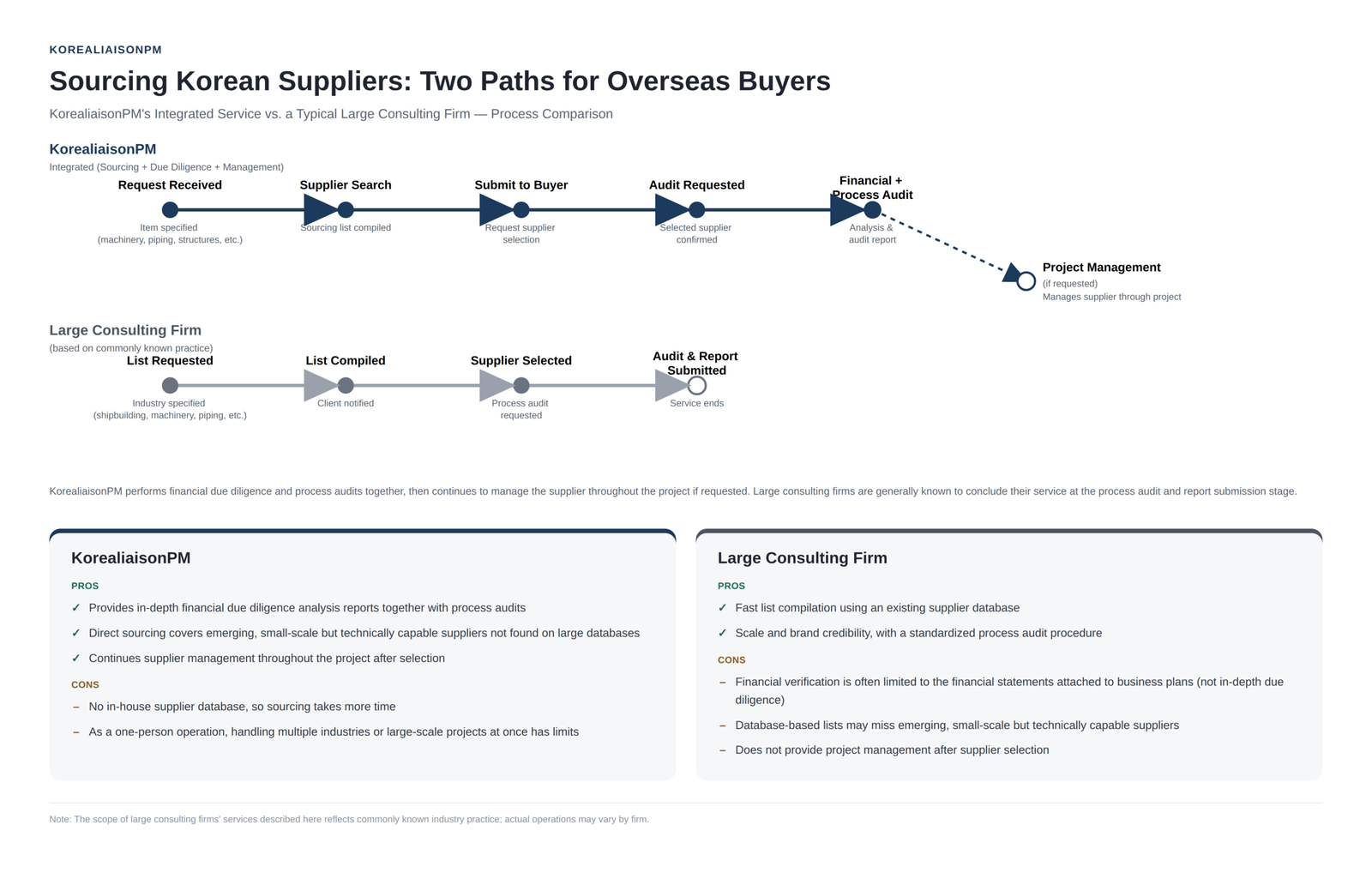
This post compares two paths — the way large consulting firms are commonly known to operate, and the integrated service KorealiaisonPM provides.
Path 1: Going Through a Large Consulting Firm
The process generally works like this:
- The overseas buyer specifies a category (machinery, piping, structures, etc.) and requests a supplier list.
- The consulting firm compiles a list from its existing supplier database and delivers it to the client.
- Once the buyer selects a supplier from the list, the firm carries out a process audit.
- The audit report is submitted, and the service is generally understood to end there.
Pros
- Fast list compilation, since the firm already has a supplier database. Useful when timelines are tight.
- Scale and brand credibility, backed by a standardized process audit procedure.
Cons (based on commonly known practice)
- Financial verification is often limited to the financial statements attached to the supplier’s business plan — a different level of scrutiny than in-depth due diligence.
- Because the list is database-based, emerging or small-scale suppliers with strong technical capability may never make it onto the list in the first place.
- The firm’s role typically ends at supplier selection and process audit; project management after that point is usually not included.
Path 2: KorealiaisonPM’s Approach
KorealiaisonPM combines the front end of this process (supplier discovery and listing) and the back end (financial due diligence and process audit) into a single continuous workflow, and adds ongoing project management on top of it.
- The buyer’s requirements are received (e.g. machinery, piping, structures).
- Suppliers are sourced directly and a shortlist is compiled. This takes more time than pulling from an existing database, but allows for a broader and more careful search.
- The shortlist is submitted to the buyer.
- Once the buyer selects candidates, an audit is requested and carried out.
- Financial due diligence is performed and documented in an analysis report, alongside a process audit and its report.
- The service doesn’t end there — if the buyer requests it, supplier management continues for the duration of the project.
Pros
- In-depth financial due diligence analysis, delivered together with the process audit — a step beyond checking business-plan-level financial statements.
- Because sourcing is done directly rather than pulled from a database, emerging and small-scale suppliers with real technical capability can be included.
- Supplier management continues throughout the project after selection, so progress isn’t lost once the contract is signed.
Cons
- No in-house supplier database, so sourcing takes more time.
- As a one-person operation, handling multiple industries or very large-scale projects simultaneously has its limits.
What Buyers Should Check Before Committing
Whichever path fits your project, it’s worth confirming a few things before signing on:
- Is the supplier list built from an existing database, or sourced directly?
- Is financial verification limited to business-plan-level statements, or does it include a deeper analysis report?
- Does the service include supplier management once the project is underway, or does it end at the audit report?
Closing Thoughts
Note: The description of large consulting firms above reflects commonly known industry practice; actual operations may vary by firm.
Both paths have their place. If you need fast, standardized list compilation, a large consulting firm may be the better fit. If you want a broader search that includes suppliers outside the usual databases, combined with deep financial due diligence and continuous project management, KorealiaisonPM’s approach may serve you better.
If you’re planning to source from Korea, it’s worth starting by figuring out which path actually fits your project.